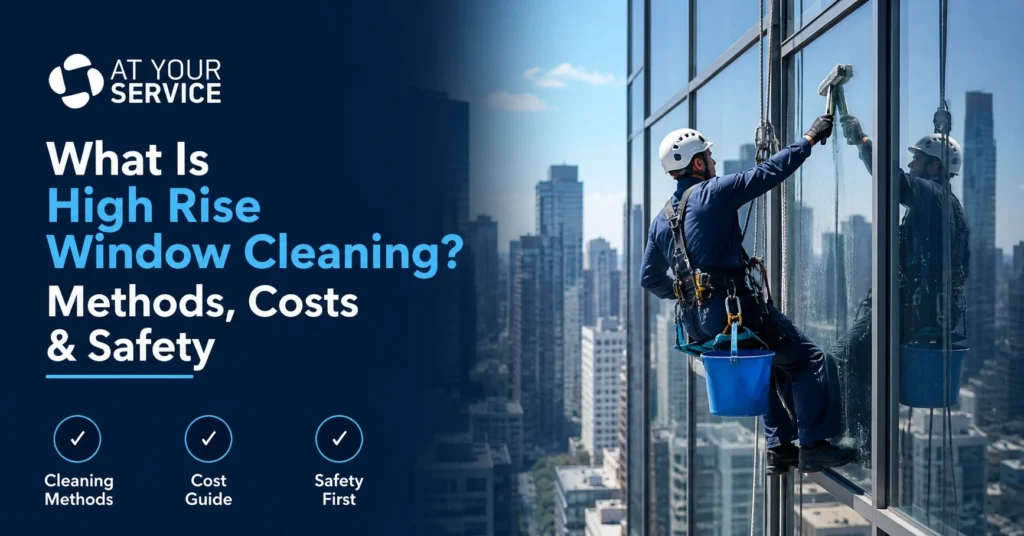
High rise window cleaning is the practice of cleaning exterior glass on tall buildings using specialised access methods such as rope access, suspended platforms, or aerial lifts, rather than standard ladders or poles. The method used depends on the building’s height, facade design, and surrounding access. For most New Zealand high rise buildings, industrial rope access is the primary method, carried out by certified technicians under strict WorkSafe NZ regulations.
In this guide, you’ll learn what high rise window cleaning actually involves, the main methods used in NZ, what determines cost, the safety standards that protect both technicians and the public, and what to check before hiring a contractor.
Quick Answer: High rise window cleaning uses rope access, suspended platforms, or building maintenance units to clean exterior glass on buildings too tall for ground based equipment. In NZ, rope access by IRATA certified technicians is the most common method for buildings above six storeys, governed by WorkSafe NZ best practice guidelines and anchor certification under AS/NZS 1891.4. Costs in NZ typically range from $500 to $1,500 or more per visit, depending on height, access complexity, and facade design.
High Rise Window Cleaning Method Comparison
| Method | Best Suited For | Typical NZ Use | Disruption Level |
| Rope access (abseiling) | Buildings 6 to 40 storeys, complex facades | Most common method in NZ | Minimal, no ground equipment needed |
| Building maintenance unit (BMU) | Very tall towers, usually 35+ storeys | Limited in NZ, mainly major cities | Low, but requires permanent installed system |
| Aerial work platform (boom or scissor lift) | Mid rise buildings with open ground access | Common for buildings under 6 storeys | Moderate, requires ground space |
| Water fed pole (pure water system) | Buildings up to roughly 6 storeys from the ground | Widely used for low and mid rise | Very low |
| Suspended platform or cradle | Buildings with permanent platform infrastructure | Some commercial towers | Low once installed |
| Scaffolding | Specific repair or post construction work | Rare for routine cleaning, costly | High |
What Is High Rise Window Cleaning?
High rise window cleaning refers to the cleaning of exterior glass on buildings tall enough that standard ground based tools, such as extension poles or ladders, cannot safely or effectively reach the windows. For buildings up to about six storeys, water fed pole systems can typically handle the job from the ground. Anything above that generally requires rope access or another specialised method.
This is genuinely different work from standard window cleaning, both in technique and in regulation. High rise cleaning is a specialised service that requires formal certification, dedicated safety equipment, and detailed planning on every job. This work is governed by strict workplace health and safety regulations, and technicians must hold current working at heights and rope access certifications.
In our experience working alongside high rise and commercial access teams across New Zealand, the question building owners ask most often isn’t really about the glass itself, it’s about risk. Who is liable, what happens if something goes wrong, and how do I know the contractor is actually qualified to be on my building. Those are exactly the right questions, and this guide answers all three.
High Rise Window Cleaning Methods Used in NZ
Rope Access (Abseiling)
Rope access is the dominant method for high rise window cleaning across New Zealand, and for good reason.
The two main compliant methods in New Zealand are industrial rope access and suspended platform systems. WorkSafe NZ endorses industrial rope access as a compliant work at height method when carried out by certified technicians operating under its best practice guidelines.
Rope access uses two ropes, one for working and one for safety backup. Both ropes connect to certified anchor points on the roof that are tested to hold heavy loads. Technicians wear secure harnesses and use controlled descent devices to move up or down the building, giving them steady control even on uneven or curved surfaces.
In most cases, no internal building access is required. Exterior window cleaning and building washing are completed entirely from outside using rope access. Internal access is only needed when specific anchor points or roof entry is required.
This is why rope access has become the standard choice for most NZ commercial towers. It is often more cost effective for mid to high rise buildings, especially between 6 and 40 storeys, since setup time is short and technicians can reach almost any section without blocking roads or walkways.
Building Maintenance Units (BMUs)
BMUs are the best option for very tall buildings, usually anything above 35 or 40 storeys. They work well on skyscrapers with smooth facades or gentle curves since the cradle can move along the full surface without interruption. In New Zealand, BMUs are far less common than rope access due to the comparatively limited number of buildings at that extreme height, and the high installation cost of a permanent system. They are typically found on a handful of major towers in Auckland’s CBD.
Aerial Work Platforms
Aerial work platforms, including boom lifts and scissor lifts, give cleaners a stable platform and are common on mid rise buildings or in areas with enough open space for equipment to move safely. These suit commercial buildings up to roughly six storeys where there is adequate ground clearance for the machinery, without the cost and complexity of rope access certification.
Water Fed Pole Systems
For lower and mid rise buildings, a pure water system with a long water fed pole is commonly used. Water is filtered to remove all minerals and impurities, then pumped through a long pole with a soft brush to clean glass without the need for ladders or elevated access. This method extends the practical reach of standard window cleaning before specialised height access becomes necessary, and we cover the technique in more depth in our guide on how to clean windows without streaks.
Emerging Methods: Window Cleaning Robots
Autonomous window cleaning robots are an emerging technology in the high rise sector, primarily used overseas on large flat glass facades. They remain uncommon in New Zealand due to the country’s relatively limited number of glass curtain wall skyscrapers and the higher cost of robotic systems compared to a trained rope access team. For the vast majority of NZ high rise buildings, rope access remains the more practical and cost effective option.
How Safe Is High Rise Window Cleaning?
This is the question every building owner should ask before engaging anyone for this work, and it deserves a direct, well sourced answer.
Rope access is regulated by bodies such as IRATA, the Industrial Rope Access Trade Association. When carried out by trained professionals, it is considered one of the safest methods due to rigorous equipment checks and strict procedures.
Industry safety data shows rope access incident rates have continued to decrease while elevated work platform incident rates have trended upward over the same period, which reflects the redundancy built into the rope access system: two independent ropes, one for working and one purely for fall arrest.
In New Zealand, this work sits under formal government guidance. The Department of Labour, now part of WorkSafe NZ, published Industrial Rope Access in New Zealand: Best Practice Guidelines in conjunction with the Industrial Rope Access Association of New Zealand, setting out the safety framework for this work nationally.
A critical, often overlooked compliance point sits with the building owner, not just the contractor. WorkSafe NZ requires permanently installed anchor points to be tagged and re-certified annually under AS/NZS 1891.4 before any rope access contractor can use them. A WorkSafe safety alert places this obligation directly on the person conducting a business or undertaking who has control over a building with permanently installed height safety systems. If certifications have lapsed, a contractor cannot legally use those anchors until they are inspected and re-certified.
This means building owners and body corporates carry real responsibility here too, not just the window cleaning company. Confirming your building’s anchor certification status before booking work avoids delays and ensures the job can legally proceed on the scheduled date.
What Determines High Rise Window Cleaning Cost in NZ?
Typical NZ Pricing
Cleaning windows on high rise buildings in Auckland can cost anywhere from $500 to $1,500 plus GST per visit, depending on the number of floors, accessibility, and safety protocols in place. Commercial properties, especially high rises, typically run from around $150 to $300 or more per visit for smaller commercial sites, scaling up significantly for genuine high rise towers.
Why Height Increases Cost So Significantly
The primary driver of cost is the access method required. Rope access requires IRATA certified technicians, rigging from roof level, site specific safety planning, and specialist equipment, none of which is needed for ground based cleaning.
A reputable commercial window cleaning company carries substantial public liability insurance, generally a minimum of several million dollars, as standard for this kind of work, alongside workers’ compensation cover. Without this insurance, liability for any incident on site can fall back on the building owner. This insurance cost is built into the pricing structure for legitimate high rise contractors and is one reason quotes from properly certified operators sit meaningfully higher than informal or uninsured alternatives.
What Affects the Final Quote
Building height and floor count.
More storeys mean more rigging time, longer descent cycles, and greater technical complexity per elevation.
Facade complexity.
Rope access provides access to complex facade geometry, recessed windows, and architectural features that a gondola or platform system cannot always navigate, but this complexity also adds time and cost to the job.
Scope of the quote.
Some quotes cover glazing panels only. Others include frames, sills, reveals, and the building base. A quote covering only the glass can appear more competitive than one covering the full scope, but the comparison is not accurate if the specification differs. Always clarify exactly what surfaces are included before comparing prices between contractors.
Frequency and contract length.
Ongoing programmes with a single contractor typically cost less per clean than repeated one off quotes, since the contractor avoids repeating site assessment and rigging documentation each visit.
Who Is Responsible if Damage Occurs During High Rise Window Cleaning?
Responsibility for damage during high rise window cleaning depends on the circumstances of the incident, but in most cases, a properly insured contractor is responsible for any damage caused by its employees, equipment, or work activities.
This is one of the primary reasons commercial property owners should only engage qualified, fully insured contractors for work at height. Reputable high rise window cleaning companies carry substantial public liability insurance and workers’ compensation cover specifically to protect both the contractor and the building owner if an incident occurs on site.
However, liability does not always sit solely with the contractor. Building owners and body corporates also have legal responsibilities under New Zealand health and safety legislation, particularly in relation to permanently installed height safety systems. For example, if roof anchor points have not been inspected and re-certified as required under AS/NZS 1891.4, and an incident occurs because those systems were not properly maintained, responsibility may extend beyond the cleaning contractor.
For this reason, building owners should always request proof of current public liability insurance, confirm the contractor’s certifications, and ensure all permanently installed anchor systems have valid inspection records before work begins.
As a practical rule, if a contractor cannot provide evidence of insurance, certifications, and a site specific safety plan, they should not be working on your building.
How Often Should a High Rise Building Be Cleaned in NZ?
There’s no single universal answer, but clear patterns exist based on NZ field data.
Most CBD commercial buildings benefit from two exterior cleans per year. This addresses the mould and algae growth that accumulates over winter and the salt film that builds up through warmer months when wind carries marine air across the city.
Waterfront and coastal exposure buildings typically need three to four cleans annually, since salt deposition is significantly higher in those locations. The right frequency for any specific building depends on its location, orientation, height, and facade type, which is why an experienced contractor will generally assess the building before recommending a schedule rather than applying a one size fits all answer.
Will High Rise Window Cleaning Disrupt Tenants or Operations?
This is a genuine and reasonable concern for commercial property managers, and the answer is one of the clearer advantages of rope access over older methods.
Disruption is generally minimal. Rope access avoids scaffolding, blocked entrances, and noisy machinery. Most tenants barely notice the work being carried out. Unlike scaffolding, which can create a visible, lengthy presence around a building for weeks, rope access work is far less obtrusive, with pedestrians and occupants rarely noticing the work happening many floors above.
A managed ground level exclusion zone directly below the work area is standard practice for public safety, but this typically affects only a small footprint rather than disrupting building entrances or operations broadly.
What Should a High Rise Window Cleaning Contractor Provide?
Before engaging any contractor for this work, building owners and facility managers should expect the following as standard practice from a genuinely qualified operator.
A professional contractor should provide a site specific safety plan before work starts, and a written completion report with photographs afterwards. Before every job, especially high rise or rope access work, a qualified company prepares a site specific Safe Work Method Statement that identifies every hazard and the control measures in place. Requesting this document before approving any work is sound risk management, not an unreasonable ask.
At minimum, confirm the contractor can provide:
- Current IRATA or equivalent rope access certification for all technicians on site
- A site specific safe work plan before work begins
- Proof of public liability insurance and workers’ compensation cover
- Confirmation of your building’s anchor point certification status under AS/NZS 1891.4
- A written completion report with photographic evidence after the job
Does High Rise Window Cleaning Include Other Glass and Surfaces?
Most reputable contractors extend their scope beyond standard window panels when working at height, since the access cost is already incurred.
Many high rise cleaning teams also clean solar panels, skylights, atriums, and other accessible glass surfaces using the most appropriate method for each location while already rigged for the main job. If your building has solar installations or architectural glass features, it’s worth asking whether these can be included in the same visit rather than booked as a separate service.
Frequently Asked Questions
How often should a high rise building be washed or cleaned?
Most CBD commercial buildings benefit from two exterior cleans per year, addressing seasonal mould, algae, and salt build up. Waterfront and coastal exposure buildings typically need three to four cleans annually due to higher salt deposition.
Is rope access safe for window cleaning?
Yes, when carried out by certified technicians following proper procedures. Rope access is regulated by bodies such as IRATA and, when carried out by trained professionals, is considered one of the safest height access methods due to rigorous equipment checks and strict procedures. In New Zealand, the work is also governed by WorkSafe NZ best practice guidelines and mandatory annual anchor point certification.
Will high rise window cleaning disrupt tenants or operations?
Generally not significantly. Rope access avoids scaffolding, blocked entrances, and noisy machinery, and most building occupants barely notice the work taking place. A small ground level exclusion zone directly below the work area is standard for public safety but rarely affects building access.
How do you prevent streaking or residue on high rise glass?
Most professional high rise cleaners use purified or deionised water systems that remove contaminants without leaving mineral residue or streaks. This produces a longer lasting, spot free finish compared to standard tap water cleaning.
Do high rise window cleaners clean solar panels and lower level glass?
Many do, cleaning solar panels, skylights, and all accessible glass surfaces using the most appropriate method for each location during the same visit. Confirm this is included in your quote rather than charged as a separate call out.
Can rope access teams clean buildings with complex architecture?
Yes. Rope access provides access to complex facade geometry, recessed windows, and architectural features that platforms or gondolas cannot always navigate. This is one of the primary reasons it has become the preferred method for irregular or architecturally detailed commercial buildings in NZ.
Why does high rise window cleaning cost more than cleaning lower buildings?
The primary driver is the access method required. Rope access requires IRATA certified technicians, rigging from roof level, site specific safety planning, and specialist insured equipment, none of which standard ground based cleaning needs.
What should I do before a rope access window cleaning contractor arrives on site?
Confirm the certification status of your building’s permanently installed anchor points, since WorkSafe NZ requires these to be re-certified annually under AS/NZS 1891.4. If certifications have lapsed, work cannot proceed until anchors are inspected and re-certified, which can delay the scheduled job.
Do people still clean skyscraper windows manually, or is it mostly automated?
The vast majority of high rise window cleaning globally and in New Zealand is still performed by trained human technicians using rope access, BMUs, or aerial platforms. Autonomous robotic systems exist but remain a niche solution, mainly used overseas on very large flat glass facades, and are uncommon on NZ buildings.