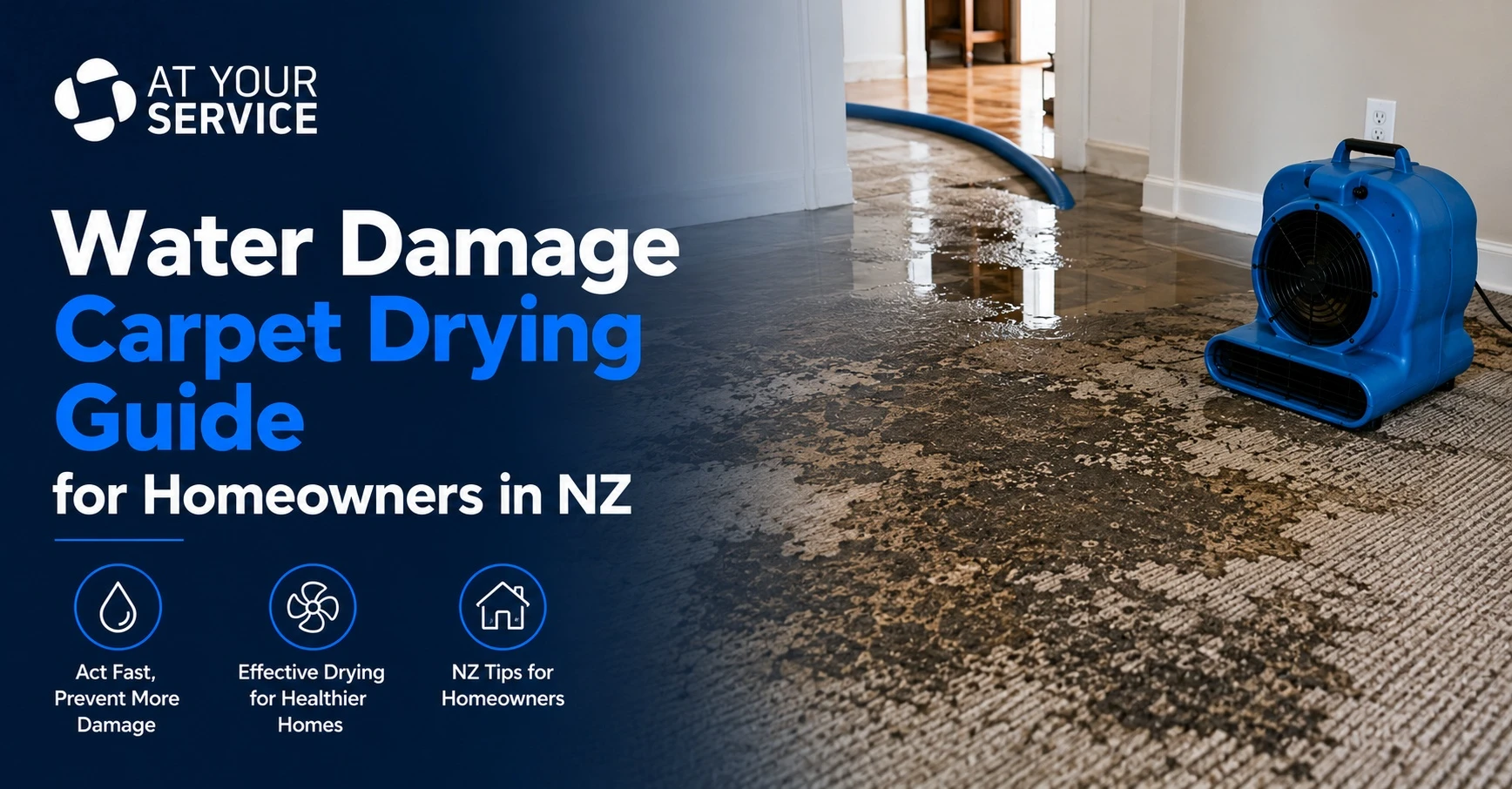
How to dry wet carpet depends on how much water is involved and how long the carpet has been wet. For small spills caught quickly, towels, baking soda, and good ventilation are often enough. For flooding, burst pipes, or carpet that has been wet for more than a few hours, a wet-dry vacuum combined with fans and a dehumidifier is the minimum equipment needed. If the carpet has been wet for more than 24 to 48 hours, mould may already be developing in the underlay, and professional drying or replacement becomes the realistic options.
In this guide, you’ll learn how to dry wet carpet fast at home using the most effective DIY methods. We cover tools, step-by-step drying, the baking soda method, how to handle flooded carpet, how to check for hidden moisture, and the situations where professional water damage restoration is the right call.
Quick Answer: Remove all furniture, extract as much water as possible using towels or a wet-dry vacuum, run multiple fans across the carpet on high, place a dehumidifier in the room, lift the carpet edge to check the underlay, and apply baking soda once the carpet is damp rather than saturated. Act within 24 hours. Mould can begin growing in wet carpet within 24 to 48 hours.
Wet Carpet Response Guide
| Situation | Urgency | Recommended Action |
| Small spill, caught immediately | Low | Towels, baking soda, ventilation |
| Larger spill, carpet soaked through | Medium | Wet-dry vacuum, fans, dehumidifier |
| Leak from pipe or appliance | High | Stop source, wet-dry vacuum, fans, check underlay |
| Flooding from outside or stormwater | Very high | Professional assessment recommended |
| Carpet wet for more than 24 hours | Critical | Professional drying or replacement |
| Sewage or contaminated water | Immediate | Do not attempt DIY. Call professionals. |
| Wet for 48 hours or more with smell | Replacement likely | Professional inspection required |
Why Acting Fast Matters: The 24 to 48 Hour Rule
This is the most important thing to understand about wet carpet.
Mould can begin growing on wet carpet within 24 to 48 hours, given the right conditions. Mould thrives in damp, dark, and humid environments, making wet carpet an ideal habitat.
Even if visibly apparent mould growth has not yet begun, it is highly likely to happen unless the carpet is completely removed, cleaned, and dried within 24 to 48 hours. Even then, removal and cleaning are not guaranteed to prevent mould growth.
The mould timeline matters because it sets a real deadline on your response:
In the first 24 hours, mould spores settle and start attaching to wet carpet fibres. By 48 hours, visible mould growth can begin. Between 3 and 7 days, widespread discolouration, staining, and heavier colonisation occur, with mould penetrating carpet backing and padding. After one to two weeks, extensive growth is likely and microorganisms can produce allergens and mycotoxins.
The underlay is where the clock moves fastest. The carpet underlay is where mould will likely grow first as it takes longer to dry than the surface. Mould feeds on the organic debris inside and below the carpet, and the underlay is spongy so it holds moisture longer.
In our experience attending water damage jobs across New Zealand, the most common situation we encounter is a carpet that looks and feels dry on the surface but has been holding significant moisture in the underlay for several days. By the time the musty smell becomes obvious, mould is already well established beneath the surface. The 24-hour window is not a guideline. It is a deadline.
What to Do Before You Start So You Stay Safe
Before touching a wet carpet, especially after flooding, safety comes first.
Turn off electricity to the affected area.
Water and live electrical circuits are a fatal combination. If there is any possibility that water has reached electrical outlets, skirting board wiring, or underfloor wiring, turn off the relevant circuit breakers before entering the room.
Identify the water source.
There are two kinds of water: sanitary and unsanitary. Sanitary water damage originates from rain and piped water. Unsanitary water originates from overflowing toilets and other sources that could be contaminated. Carpets damaged by groundwater or raw sewage need to be uplifted and discarded.
If the water source is sewage, floodwater from outside, or any source that may carry contaminants, do not attempt DIY cleaning. This is a health hazard requiring professional remediation.
Remove furniture immediately.
Remove any smaller furnishings from the carpet and place aluminium foil under the legs of furniture that cannot be moved. This helps prevent rust or furniture stains, which may become permanent.
Remove breakables and moisture-sensitive items.
Books, paper goods, fabrics, shoes, potted plants, and anything that stains or absorbs water should be moved to a dry area before you begin drying.
How to Dry Wet Carpet Fast
Step 1: Stop the Source of Water
This step is obvious but critical. No drying effort will succeed if water continues to enter the area. Identify the source and stop it completely before beginning any drying process. If it’s a burst pipe, turn off the water supply at the mains. If it’s a roof leak or window leak, contain the entry point temporarily while you begin drying.
Step 2: Extract as Much Water as Possible
Using a wet-dry vacuum is the most effective way to remove as much water from a flooded carpet as possible. If you don’t have access to one, they are available to rent at most local hardware stores.
Work slowly across the entire wet area, going over each section multiple times. The more water you extract at this stage, the faster everything else works. The more water you can remove initially, the shorter the drying time will be.
If you don’t have a wet-dry vacuum, use thick, dry towels and apply firm pressure. Press down hard, absorb, wring out, and repeat. Place heavy books or boxes on top of the towels to increase the pressure and pull more moisture upward into the towel fibres.
A surprisingly effective method involves using towels paired with weight compression. Place thick, dry towels over the wet area and weigh them down with books or a heavy box, which forces more moisture up into the towel fibres than blotting alone. Replace the towels regularly until they stop absorbing water.
Step 3: Create Maximum Airflow
Open windows and doors to improve air circulation. Use fans to blow air across the carpet, which helps speed up the drying process. High-powered fans, such as air movers, can be particularly effective in creating strong airflow over the carpet surface.
Position fans so air moves across the carpet surface and out of the room through an open window or door. Don’t just point fans downward. Angling them so air moves horizontally across the wet surface significantly increases evaporation speed.
The fan will need to be run at the optimum speed for at least three days. If the floodwater reached the walls, allow five days minimum drying to prevent black mould growth.
Step 4: Run a Dehumidifier Continuously
Fans alone move moisture but don’t remove it from the air. A dehumidifier extracts moisture and is essential for proper drying.
Place dehumidifiers in the room to lower humidity levels. This helps prevent mould and mildew growth while aiding in faster drying. Dehumidifiers are especially useful in enclosed or poorly ventilated areas where natural air circulation is limited.
Run the dehumidifier continuously throughout the drying period. Empty the water reservoir regularly or connect the drainage hose to a floor drain so it runs uninterrupted. In New Zealand’s coastal and winter conditions, humidity in the room rises quickly during drying, and a dehumidifier is not optional for preventing mould in those environments.
Step 5: How to Dry Wet Carpet with Baking Soda
Baking soda is an effective complementary drying tool for damp carpet once the bulk of the water has been extracted.
Sprinkle a generous amount of baking soda onto the damp areas. Leave it for two to four hours, then vacuum thoroughly. Let the baking soda sit on the carpet for a minimum of 30 minutes to allow it ample time to soak up remaining moisture and odour. Then vacuum the carpet thoroughly.
Once the affected area has become more damp than sopping wet, liberally sprinkle baking soda over it. Let it sit for an hour or so, then vacuum it up. Some of the moisture will be drawn into the soda, which you can then easily pick up and dispose of.
Baking soda is most effective on small damp areas. For larger areas or deeply saturated carpet, it is a useful supplementary step after extraction but not a substitute for fans and dehumidification.
NZ tip: In high-humidity regions like Auckland, Tauranga, and the Bay of Plenty, baking soda can absorb atmospheric moisture quickly and clump in the carpet during winter. Apply it only after the bulk of the water has been extracted and the surface is damp rather than wet.
Step 6: Lift the Carpet and Check the Underlay
This step is skipped in most DIY guides, which is one reason so many NZ homeowners end up with mould despite careful surface drying.
If possible, lift the carpet from the floor to allow air to circulate underneath.
Pull back the carpet from the nearest edge or corner and inspect the underlay. If the underlay is wet, it needs to be dried separately. Fans directed underneath the lifted carpet, combined with the dehumidifier running continuously, can dry damp underlay if caught early. Soaked underlay that has been wet for more than 24 hours should be replaced. No amount of surface drying resolves a soaked underlay, and laying carpet back over it will result in mould growth within days.
Exposure drying is a method employed to gain access to sublayers of textile affected by flooding. Professional drying uses powerful extraction machines and tools to salvage moisture trapped deep inside carpets, underlay, and under timber flooring, combined with low-grain dehumidifiers and air movement machines.
Step 7: Sanitise After Drying
Once the carpet is fully dry, sanitising removes bacteria and prevents the residual organic matter from causing odours or promoting future mould growth.
Wipe down walls, furniture, and any other surfaces that came into contact with the water using a sanitising solution. Once the majority of moisture has been removed, use a steam cleaner to clean and sanitise the carpet. This deep cleaning helps kill any bacteria and restore the carpet’s appearance.
For carpets that were wet due to a clean water source (burst pipe, rainfall), a thorough steam clean once fully dry is sufficient. For carpets exposed to grey water (washing machine overflow, minor flooding with potential contaminants), a specialist antimicrobial treatment is recommended before steam cleaning.
How to Dry Wet Carpet Without a Vacuum
Not everyone has access to a wet-dry vacuum. Here’s how to achieve the best possible result without one.
Thick towels with weight compression.
Stack several layers of thick, dry towels over the wet area and press heavy objects down on top. Leave for 20 to 30 minutes. Remove towels, wring them out thoroughly, and repeat. This method is slow but effective for smaller wet areas.
Use a hairdryer on small patches.
For small wet spots, you can use a hairdryer to speed up drying. Keep it moving and maintain a safe distance to avoid heat damage to carpet fibres. This method is only practical for small patches, not for large wet areas.
Air conditioning as a dehumidifier.
Your air conditioner can also help by acting as a dehumidifier. Running it on cooling mode removes moisture from the room air, which accelerates drying even when combined only with open windows rather than dedicated fans.
Maximise natural ventilation.
Open every window and door in the affected room and adjacent spaces to create cross-ventilation. Even without powered equipment, good airflow significantly speeds drying compared to a closed, humid room.
Tools for Drying Wet Carpet
| Tool | Best Used For | Effectiveness |
| Wet-dry vacuum | Initial water extraction | Very high |
| Air mover or high-powered fan | Airflow and evaporation | Very high |
| Dehumidifier | Humidity control, continuous drying | Very high |
| Baking soda | Surface moisture absorption | Moderate (small areas) |
| Thick towels with compression | Small areas without vacuum | Moderate |
| Regular household fan | Supplementary airflow | Low to moderate |
| Hairdryer | Tiny localised patches | Low (small areas only) |
| Heater | Cold weather drying support | Moderate (used with dehumidifier) |
Can a Soaking Wet Carpet Be Saved?
This is the honest question most people need answered.
Yes, if acted on within 24 hours and the water is clean (not sewage or heavily contaminated), most carpets can be saved with thorough DIY drying or professional extraction.
Replacement is likely the right decision when:
- The carpet has been wet for more than 48 hours
- The underlay is saturated and shows mould growth
- The water source was sewage, groundwater, or otherwise contaminated
- The subfloor shows water damage or mould
- A musty smell persists after thorough drying
Any carpet that has been subjected to water damage from flooding or standing water will most likely need to be disposed of. Conditions are ripe for mould growth in this case.
Waiting longer than 24 to 48 hours increases mould risk significantly. The first day is the most important window to prevent mould growth.
In our experience, the decision point we communicate to clients is clear: if the carpet has been wet for under 24 hours and the underlay is only damp, professional drying has a high success rate. Beyond 48 hours, especially in NZ’s humid climate, we are usually recommending underlay replacement at minimum and assessing whether the carpet itself can be saved. We would rather give clients an honest answer early than have them invest in drying a carpet that will develop mould within weeks regardless.
What Pulls Moisture Out of Carpet
Several methods help remove or absorb moisture from wet carpet. Understanding which does what helps you combine them effectively.
Wet-dry vacuum extraction physically removes liquid water from the carpet system. It is the fastest and most effective first step for any significantly wet carpet.
Fans and air movers create airflow that increases the rate of evaporation from the carpet surface. They move moisture-laden air out of the room but need to be paired with a dehumidifier that removes that moisture from the air.
Dehumidifiers remove moisture from the air and create a lower-humidity environment that accelerates evaporation from the carpet and underlay simultaneously.
Baking soda absorbs surface moisture and odour at the carpet fibre level. It is a useful supplementary step after extraction but cannot substitute for mechanical drying on significantly wet carpet.
Heat can accelerate drying but needs to be used with a dehumidifier simultaneously. Heating without dehumidification simply increases the amount of moisture circulating in the warm air of a closed room without removing it.
When to Call a Professional for Wet Carpet Drying
Some wet carpet situations are beyond DIY capability. Knowing when to stop trying and call a professional can save a significant amount of money compared to replacing a carpet that could have been restored with the right equipment.
Call a professional when:
- The flooding covers a large area or multiple rooms
- The water source is contaminated (sewage, groundwater, stormwater)
- The carpet has been wet for more than 24 to 48 hours
- The underlay or subfloor shows damage or suspected mould
- The smell persists despite thorough drying
- Household members are experiencing respiratory symptoms
Professional carpet drying uses a combination of powerful extraction machines, low-grain dehumidifiers, air movement machines, and air injection machines to add airflow to closed cavities such as wall cavities and under hard floor timber flooring.
For water damage that has affected underlay, subfloor, or wall cavities, a professional carpet cleaning and water damage restoration service can assess the full extent of the damage, extract moisture from layers that DIY methods cannot reach, and apply antimicrobial treatment before the carpet is re-laid. Acting early is always significantly cheaper than attempting restoration weeks after mould has established itself. If your property has experienced flooding and you’re in the end of tenancy stage of a rental, professional drying and restoration with a receipt is also the strongest protection against bond disputes over water damage.
How to Prevent Wet Carpet Damage in Future
Respond to spills in the first 5 minutes. The faster a spill is blotted and extracted, the less it penetrates into the underlay. Keep dry towels accessible and respond immediately.
Check for hidden leaks regularly. Slow leaks from dishwashers, washing machines, hot water cylinders, and roof areas are a primary source of chronic wet carpet in NZ homes. A musty smell in one area of carpet without an obvious cause should trigger a leak investigation.
Use entrance mats. In NZ’s wet climate, mats at every exterior door capture significant moisture from footwear before it reaches carpet.
Control indoor humidity. If relative humidity stays above 60%, drying slows significantly. This creates a breeding ground for mould even in carpets that were never visibly flooded. Run a dehumidifier in prone areas during winter and wet seasons.
Schedule regular professional carpet cleaning. Professional hot water extraction removes the organic matter that mould feeds on and verifies that no hidden moisture issues are developing in the underlay.
Frequently Asked Questions
How do you dry wet carpet fast at home?
Extract as much water as possible using a wet-dry vacuum or towels with firm pressure. Run multiple fans across the carpet surface on high speed. Place a dehumidifier in the room running continuously. Apply baking soda once the carpet is damp rather than saturated. Lift the carpet edge to check the underlay. Act within the first 24 hours to stay ahead of mould growth.
How do you dry wet carpet with baking soda?
Sprinkle a generous amount of baking soda onto the damp carpet. Leave it for two to four hours, then vacuum thoroughly. Baking soda absorbs surface moisture and neutralises odours. It works best as a complementary step after the bulk of the water has been extracted, not as a standalone drying method for significantly wet carpet.
How do you dry wet carpet without a vacuum?
Use multiple layers of thick, dry towels pressed firmly onto the wet area with heavy objects on top to force moisture upward into the towel fibres. Replace and wring out towels repeatedly. Then run fans across the surface continuously and use a dehumidifier. For small patches, a hairdryer on a low heat setting can help. Allow maximum ventilation by opening all windows and doors.
How long can carpet be wet before it is ruined?
Mould can begin growing on wet carpet within 24 to 48 hours. Once that window is exceeded, the likelihood of successful drying drops sharply and the risk of mould contamination rises significantly. Carpet wet for more than 48 hours, particularly if the underlay is saturated, often requires underlay replacement at minimum. Carpet wet for more than 72 hours in a warm, humid environment typically needs full replacement.
Will damp carpet dry on its own?
A lightly damp carpet in a well-ventilated room with good natural airflow may dry on its own over several hours. A significantly wet carpet left to dry passively in a closed room will not dry fast enough to prevent mould growth. Active drying using fans, a dehumidifier, and water extraction is necessary for any carpet that is more than slightly damp.
What pulls moisture out of carpet?
The most effective combination is a wet-dry vacuum for initial extraction, high-powered fans for surface evaporation, and a dehumidifier for removing moisture from the air. Baking soda helps absorb surface dampness and odours. Heat can assist in cold conditions when used alongside a dehumidifier.
Can a soaking wet carpet be saved?
If the carpet is addressed within 24 hours and the water source is clean (not sewage or contaminated), most carpets can be saved with thorough drying. If the carpet has been subject to standing water and has been wet beyond 24 to 48 hours, it is highly likely to need replacement even after cleaning and drying attempts.
Is a dehumidifier or fan better for drying wet carpet?
Both are necessary and work together. Fans are generally more effective for initial surface drying, while dehumidifiers remove moisture from the air and create conditions that allow the carpet to continue releasing moisture over time. Using only fans without a dehumidifier simply circulates humid air without removing it. Using only a dehumidifier without fans significantly slows the evaporation rate from the carpet surface. The fastest and most effective drying uses both simultaneously.
How long does it take to dry wet carpet completely?
With fans running at optimal speed, a standard water-damaged carpet takes at least three days to dry. If floodwater reached the walls, allow five days minimum to prevent mould growth. Drying time varies with carpet thickness, underlay type, humidity, airflow, and how much water was involved. Professional moisture meters are the only reliable way to confirm that carpet and underlay are fully dry.