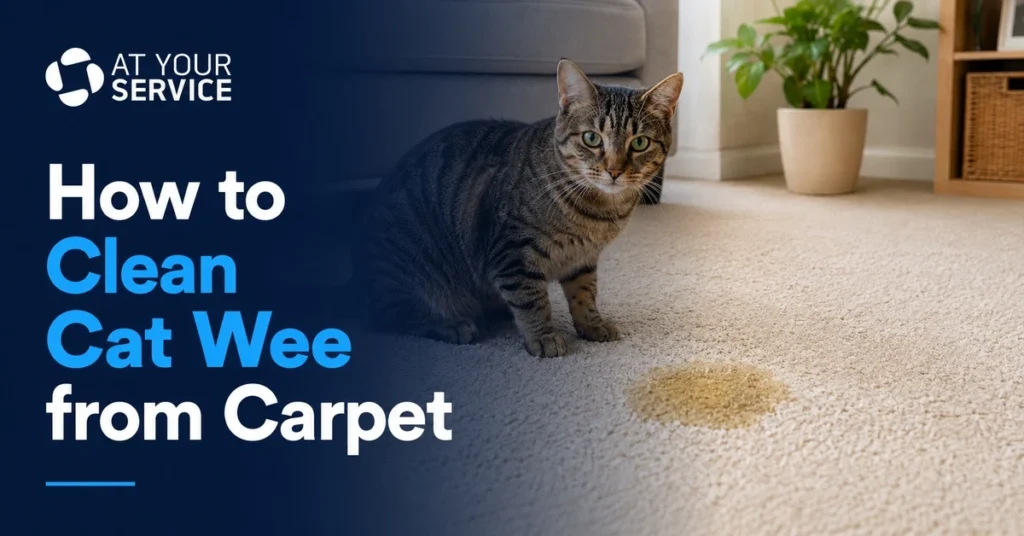
How to clean cat wee from carpet depends on how fresh the accident is and which layer of carpet the urine has reached. For fresh accidents, blotting quickly and applying an enzyme cleaner gives the best result. For dried cat urine, home remedies like baking soda and vinegar reduce the odour temporarily, but only an enzyme cleaner breaks down the uric acid crystals that cause the smell to return. If the smell keeps coming back no matter what you try, the urine has almost certainly soaked into the underlay, and surface treatments will not permanently resolve it.
In this guide, you’ll learn how to clean cat pee from carpet step by step, covering fresh spills, dried and old stains, home remedies, enzyme cleaners, prevention, and the situations where professional cleaning is the realistic solution.
Quick Answer: Blot immediately without rubbing. Apply enzyme cleaner generously enough to reach the underlay. Leave for 15 to 30 minutes. Blot dry. Sprinkle baking soda over the damp area, leave overnight, then vacuum. For old dried stains, locate the full extent first using a UV blacklight, then apply enzyme cleaner to the complete contaminated area.
Cat Wee Cleaning Quick Reference
| Situation | Best Approach | Permanent Result? |
| Fresh accident, just happened | Blot thoroughly, then enzyme cleaner | Yes, if treated within the hour |
| Fresh accident cleaned with water only | Re-treat with enzyme cleaner immediately | Yes, if underlay not saturated |
| Dried stain, smell present | UV blacklight to map stain, enzyme cleaner | Usually yes, may need repeat |
| Old smell returning after cleaning | Enzyme cleaner to underlay depth, check padding | Depends on underlay saturation |
| Smell with no visible stain | UV blacklight to locate, then enzyme cleaner | Yes, once all spots are found |
| Smell persists after multiple treatments | Professional extraction | Yes, professional treatment needed |
| Repeat accidents same spot | Professional treatment plus deterrent strategy | Professional assessment recommended |
Why Cat Urine Smells So Bad?
Before reaching for any product, understanding why cat pee smells the way it does is the most useful thing you can read. It explains why some methods work and others don’t.
Cat urine is a concentrate of metabolic waste comprising urea, creatine, uric acid, electrolytes, and bacteria. After a cat urinates, bacteria decompose the urea and release an ammonia-like odour. As decomposition continues, mercaptans form. These are the same compounds that give skunk spray its characteristic smell.
Cat urine is also more concentrated than most other animals’ urine because cats naturally drink less water. When fresh, cat urine may not smell as strong. As it breaks down, the uric acid creates crystals that are tough to remove and can linger on surfaces for years. The longer cat urine sits, the worse it smells.
The reason the smell keeps returning is specific and important. When indoor humidity levels rise from cooking, showering, drying clothes, or warm weather, those humidity levels reactivate latent uric acid deposits and the terrible odour returns. Many cleaning products remove the liquid content of urine. Some remove the stain-causing pigmentation. But nothing removes the uric acid crystals that cause odour except enzyme cleaners specifically designed to break down urine.
In New Zealand’s climate, this matters more than most guides acknowledge. Coastal humidity, damp winters, and limited ventilation in older NZ homes all create the conditions that repeatedly reactivate uric acid crystals, sometimes years after the original accident.
Cat urine contains components that require enzymes to break down the chemical bonds. Vinegar and baking soda work to neutralise the odour temporarily, and hydrogen peroxide is 30% more oxidising than chlorine. But these methods cannot fully dissolve the uric acid crystals that are the root source of the smell.
How to Clean Cat Wee from Carpet Step by Step (Fresh Cat Wee)
Step 1: Blot Immediately
Use paper towels or a clean rag to blot the urine spot, pressing down firmly to absorb as much liquid as possible. Avoid scrubbing, which can spread the stain further into the carpet fibres.
Work from the outer edge of the wet area inward. Keep blotting with fresh paper towels until no more moisture transfers. The more urine physically removed at this stage, the less there is for any cleaning product to deal with.
Do not use hot water. Heat accelerates the bonding of uric acid crystals to carpet fibres and can permanently set the stain before treatment begins.
Step 2: Apply a Vinegar Solution
Mix a solution of vinegar and water at a ratio of 1 to 1. Apply generously on the affected area to loosen the ammonia particles and neutralise the cat pee odour. Allow the solution to sit for 5 to 10 minutes to neutralise the smell, then use clean towels to absorb all the solution from the carpet.
Vinegar’s acidity neutralises the alkaline ammonia in fresh urine effectively. It also kills surface bacteria. It does not break down uric acid crystals, which is why it must be followed by an enzyme cleaner for a permanent result.
One product to avoid entirely: Never use any cleaner containing ammonia on cat urine. Ammonia is a component of cat urine, and using ammonia-based cleaners can set the stain and attract your cat back to that area repeatedly.
Step 3: Use Baking Soda to Neutralise Odour
Baking soda is an effective substance in neutralising cat pee odour. After cleaning the area, sprinkle baking soda generously, let it sit for 15 to 30 minutes, sometimes overnight, then vacuum.
Baking soda absorbs residual odour compounds at the surface level and draws remaining moisture upward. It is the right finishing step after vinegar treatment but should always be followed by an enzyme cleaner for complete odour elimination.
Step 4: Apply an Enzyme Cleaner
This is the most important step and the only one that permanently eliminates cat urine odour at its source.
An enzyme cleaner with live bacteria eliminates the stubborn odour source by permanently dissolving the stain. Typical carpet cleaners leave behind spots or temporarily mask odours, making urine stains considerably harder to remove after they have dried. Spray the affected area with enzyme cleaner and saturate it. Allow the product to remain on the surface until it dries. For heavily soiled areas with strong odour, saturate the area and cover with a clean cloth. Allow it to remain for 4 to 5 hours.
Apply the enzyme cleaner generously enough to penetrate through the carpet surface, the backing, and into the underlay. A light mist on the surface will not reach the depth the urine has already penetrated. The enzymes need adequate dwell time to complete their biological breakdown. Do not rinse the enzyme cleaner off early.
NZ Enzyme Cleaners Available Locally
Enzyme cleaners are widely available in New Zealand from supermarkets, pet stores, and veterinary suppliers. Products available in NZ include Odorex (from Odorex NZ), urineFREE, Simple Green Cat Stain and Odour Remover, and Bio-Zet Attack. When choosing, look specifically for products that state live bacterial cultures or enzymatic formula designed for urine.
How to Clean Old and Dried Cat Urine from Carpet
Old dried cat urine is a different challenge. The uric acid has already crystallised, the stain may no longer be visible, and standard products will not reach the source.
Locate the Full Stain with a UV Blacklight
This step is skipped in most DIY guides, and it is the most common reason repeated cleaning fails.
Pet urine stains are easy to find when wet but very difficult to locate once dried. A UV blacklight torch makes it simple to find hidden urine stains on carpets, furniture, and other surfaces. Let your eyes adjust for at least 30 seconds in complete darkness, then move slowly through your home. Areas with pet pee will glow a dull white or yellow colour.
Urine spreads laterally under the carpet surface, so the actual contaminated area is often significantly larger than the spot you can smell. Always treat a slightly larger area than the UV light reveals.
UV blacklights are available in NZ from hardware stores and online retailers for under $20. They are among the most practical tools any NZ cat owner can have.
Rehydrate the Dried Stain
Before applying enzyme cleaner to a fully dried old stain, lightly mist the area with cool water. This rehydrates the uric acid crystals slightly and allows the enzyme cleaner to penetrate more effectively.
Apply Enzyme Cleaner Generously and Allow Full Dwell Time
For old and dried stains, apply the enzyme cleaner far more generously than for fresh accidents. When pet urine dries, uric acid forms microscopic crystals that adhere to carpets, fabrics, and concrete. These crystals can remain even after the liquid evaporates. If an area with uric acid crystals gets wet from humidity, cleaning, or a pet re-marking, the odour can return because the crystals dissolve slightly and release ammonia-like smells.
Cover the treated area with a damp cloth or plastic wrap to prevent the enzyme cleaner from drying out before it finishes working. Leave for at least 30 minutes. For very old or heavily soiled areas, leave for several hours.
Old Cat Urine Odour Removal Through Home Remedies
For situations where enzyme cleaner is not immediately available, these home remedies are the most effective DIY options. They will reduce odour significantly but should always be followed up with enzyme cleaner for permanent results.
Vinegar and Baking Soda Combined
Pour distilled white vinegar diluted with water over the affected spot. After blotting the vinegar, sprinkle a generous layer of baking soda over the damp area. As the vinegar and baking soda react, they create a bubbling action that helps lift deep-seated debris to the surface. Once dry, vacuum the powder away. This is a good temporary fix but follow up with enzyme cleaner for long-term results.
Hydrogen Peroxide and Dish Soap
Make a solution of half a cup of hydrogen peroxide with a teaspoon of washing-up liquid. Apply to the stain and use a scrubbing brush to provide a thorough clean. Cover the area with aluminium foil to stop anyone walking on it while it remains damp.
Use only 3% pharmacy-grade hydrogen peroxide. Always test on a hidden area first, as hydrogen peroxide can lighten darker carpet colours. Do not use on wool carpet without specialist advice.
Dishwashing Liquid and Cold Water
For light fresh stains as an immediate first response, mix a few drops of non-bleach dishwashing liquid with cold water. Apply to the stain, work gently into the fibres, blot thoroughly, and rinse with cold water. Follow with baking soda and then enzyme cleaner.
Why the Smell Keeps Coming Back
If you’ve cleaned the area multiple times and the smell still returns, here is the honest explanation.
Cat pee is packed with uric acid. The longer cat urine stays on a surface, the tighter it bonds to it. When uric acid comes into contact with humidity, the uric acid crystals left behind reform and re-release the bad smell. And while it smells foul to you, it smells like a designated territory to your cat, which is why they frequently return to the same spot.
The three specific reasons smell keeps returning are:
The enzyme cleaner was not applied deeply enough.
The product must reach every layer the urine reached. Surface application alone will not resolve contamination in the underlay.
The full extent of the stain was not treated.
Without a UV blacklight, it is easy to treat only the visible or strongest-smelling area while leaving adjacent contaminated zones untouched. Cats often use the same spot repeatedly over months, creating a contamination area significantly larger than any single accident.
The underlay needs replacing.
After multiple repeat accidents in the same spot over time, the underlay absorbs more urine than any surface treatment can reach from above. In this situation, professional extraction or underlay replacement is the only permanent solution.
In our experience treating cat urine in NZ homes across multiple years of carpet cleaning, the most common scenario is a cat that has been using the same spot repeatedly, often undetected, before the owner became aware of the problem. By that point, the contamination has soaked through multiple layers. Surface treatments, however thorough, simply cannot reach it. A professional carpet cleaning service using commercial-grade hot water extraction can flush contamination from both carpet and underlay simultaneously, which is the only method that reliably resolves deep, long-term cat urine contamination.
How to Prevent Your Cat Returning to the Same Spot
Cleaning thoroughly is necessary but not sufficient if any uric acid residue remains. Cats are driven to return to the same spot to re-mark their territory if the smell is not completely neutralised. Odours must be neutralised completely, not just deodorised, to break the cycle of repeat accidents.
Once cleaned, apply a citrus-based deterrent spray to the area. Cats strongly dislike citrus scents. Products containing citrus essential oils are available from NZ pet stores and will discourage re-marking on a cleaned area.
Litter box management matters too.
Most cats will avoid their litter box if it is not cleaned regularly. Keeping a clean litter tray is one of the most effective ways to avoid dealing with the strong smell of aged cat urine on carpet.
Additional practical steps to reduce accidents:
- Add an extra litter box, particularly in a larger home or with multiple cats
- Position litter boxes in quieter, more accessible locations
- Use unscented litter if your cat seems to be avoiding the tray
- Consider placing a training pad beneath the litter box to catch any overspray
Check for health issues.
Cats with urinary tract infections, kidney disease, or bladder infections often produce more pungent urine and may urinate outside the litter box more frequently. If accidents are increasing in frequency or your cat seems distressed, a veterinary check is worth arranging before investing further in carpet treatment.
Does Cat Pee Smell Ever Go Away on Its Own?
No. Cat urine odour does not disappear on its own over time. Uric acid forms insoluble crystals that embed into surfaces. These crystals can remain even after the liquid evaporates. As cat urine ages, the bacterial activity that breaks down urea into ammonia continues, and the odour typically worsens rather than diminishes.
What can happen is that the smell becomes less noticeable during dry weather or good ventilation, leading homeowners to believe the problem has resolved. When humidity rises again or the heating comes on, the uric acid crystals reactivate and the smell returns. This is why “it seemed fine for months and then came back” is such a common experience among NZ cat owners.
The only way to permanently eliminate cat urine odour is to break down the uric acid crystals at a molecular level. Enzyme cleaners are the only consumer product category that achieves this.
Do You Need a Separate Enzyme Cleaner for Dog and Cat Urine?
Not necessarily, but it depends on the product. Most enzyme cleaners marketed for pet urine work on both dog and cat urine. However, cat urine contains additional compounds including felinine, a sulphur-containing amino acid specific to cats, that gives cat urine its particularly pungent character. Cat urine contains specific compounds including concentrated uric acid and felinine that make it more chemically complex than dog urine. A product specifically formulated for cat urine will address these compounds more effectively than a generic pet urine cleaner.
If a generic pet enzyme cleaner has not been effective on cat urine, switching to a product specifically formulated for cat urine is worth trying before concluding that professional cleaning is needed.
Cleaning Other Pet Messes from Carpet
Cat Vomit and Hairballs
Remove all solid material first using a spoon or blunt scraper. Work from the outside edge inward to avoid spreading. Blot remaining moisture with paper towels. Apply a solution of one teaspoon of dish soap in two cups of cold water, blot gently, then apply enzyme cleaner to break down any organic residue. Sprinkle baking soda over the damp area, leave for several hours, then vacuum.
Pet Hair Embedded in Carpet
Pet hair embeds in carpet fibres and can contribute to pet odour over time by trapping organic debris and moisture. For pet hair removal, use a rubber glove dampened with water and run your hand across the carpet surface in sweeping motions. The static from rubber attracts hair effectively. A rubber-edged squeegee tool or a stiff rubber brush works well for larger areas. Follow with a thorough vacuum using a rotating brush head.
When to Call a Professional
Some cat urine situations are beyond what any home treatment can permanently resolve. Call a professional when:
- The smell returns repeatedly despite thorough enzyme cleaner treatment
- Multiple accidents have occurred in the same spot over an extended period
- The underlay shows staining or smells strongly when the carpet is lifted
- The property is a rental approaching an inspection where carpet condition affects the bond refund
- Household members are experiencing allergy symptoms that worsen when indoors
For persistent cat urine issues that home methods have not resolved, a professional carpet cleaning service can assess the full depth of contamination, apply specialist enzyme treatment to the underlay directly, and extract it using commercial-grade hot water extraction. This is especially relevant in the end of tenancy cleaning context, where professional treatment with a receipt gives the strongest protection against bond deductions for pet-related carpet damage.
Frequently Asked Questions
What neutralises cat urine smell?
Enzyme cleaners specifically formulated for cat urine are the only products that neutralise cat urine smell permanently, by breaking down the uric acid crystals at a molecular level. Vinegar and baking soda neutralise odour compounds temporarily but do not dissolve uric acid crystals.
Will vinegar get cat pee smell out of carpet?
Yes, vinegar helps neutralise cat pee odour. A 1 to 1 solution of white vinegar and water loosens the ammonia particles and neutralises the smell. However, vinegar does not break down uric acid crystals, meaning the smell will return when humidity rises. Always follow vinegar treatment with an enzyme cleaner for a permanent result.
How do you get cat urine smell out of carpet after it has dried?
Locate the full extent of the dried stain using a UV blacklight in a darkened room. Lightly mist with cool water to rehydrate the crystals. Apply enzyme cleaner generously enough to saturate through to the underlay. Cover with a damp cloth and leave for at least 30 minutes. Blot dry, apply baking soda overnight, then vacuum. For stains that have penetrated deeply into the underlay, professional extraction may be necessary.
What is the most powerful urine odour eliminator?
Enzyme cleaners containing live bacterial cultures are the most powerful consumer-available odour eliminators for cat urine. They work by biologically breaking down the compounds in urine rather than masking them. For contamination that has penetrated into the underlay beyond what surface enzyme treatment can reach, professional hot water extraction combined with specialist enzyme treatment is the most powerful solution available.
What should you not use to clean cat urine?
Do not use products containing ammonia, as ammonia is a component of cat urine and will attract your cat back to the spot and set the stain. Do not use bleach on carpet, as it permanently strips dye from the fibres. Do not use steam cleaning before enzyme treatment, as heat bonds uric acid crystals deeper into the fibres.
Will cat pee smell eventually go away on its own?
No. Uric acid crystals remain embedded in surfaces even after the liquid evaporates, and the odour worsens over time as bacterial activity continues. The smell may seem to reduce temporarily in dry conditions, but it returns when humidity rises. Enzyme cleaner treatment is the only way to permanently eliminate the source.
How do I get my house to stop smelling like cat pee?
Identify all affected areas using a UV blacklight. Treat every identified spot with enzyme cleaner generously. Check the underlay in areas that have been repeatedly soiled. Address litter box management and any underlying health issues that may be causing accidents. Run a dehumidifier to reduce the ambient humidity that reactivates uric acid crystals. For widespread contamination, professional carpet cleaning is the most comprehensive and permanent solution.
How to clean cat pee from carpet without carpet cleaner?
The most effective method without commercial carpet cleaner is the vinegar and baking soda combination. Apply a 1 to 1 white vinegar and water solution, leave for 5 to 10 minutes, blot thoroughly, apply baking soda generously, leave overnight, then vacuum. Follow up with an enzyme cleaner as soon as you can obtain one.
How often should my cat visit a vet to prevent urine accidents?
Cats with urinary tract infections, kidney disease, or bladder infections often urinate outside the litter box more frequently and produce more pungent urine. Annual veterinary checks are recommended for adult cats. If accidents increase suddenly in frequency or your cat appears distressed or is straining to urinate, a vet visit should happen promptly rather than waiting for the next scheduled appointment.