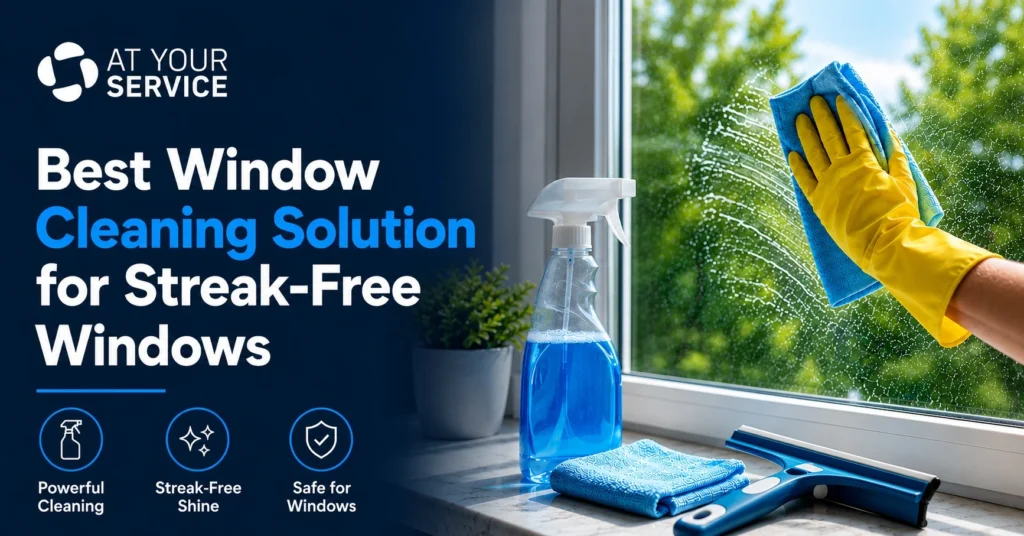
The best window cleaning solution depends on what you’re cleaning and what tools you’re using. For interior windows with light soiling, a simple vinegar and water mix delivers an excellent result. For exterior windows with grease, grime, or pollen build-up, a dish soap and water solution cuts through dirt more effectively. For professional-grade results using a water fed pole, deionised water alone is the most effective option. The most common mistake is assuming the solution does all the work. The right solution paired with the wrong technique or dirty tools will still streak.
In this guide, you’ll get exact recipes for the best homemade window cleaning solutions, a breakdown of what professional window cleaners actually use, why vinegar and dish soap should not be mixed together, and which solution works best for each specific cleaning situation.
Quick Answer: The best all-round window cleaning solution is 2 to 4 drops of mild dish soap mixed with 4 litres of warm water. For a natural alternative, use 1 part white vinegar to 10 parts warm water. Do not mix vinegar and dish soap together. Use a clean squeegee and dry microfibre cloth for the best finish. Always clean in shade, never in direct sunlight.
Best Window Cleaning Solution by Use Case
| Situation | Best Solution | Ratio | Key Note |
| Interior windows, light dust | White vinegar and water | 1 to 10 vinegar to water | Do not add dish soap |
| Exterior windows, heavy grime | Dish soap and warm water | 2 to 4 drops per 4 litres | Use distilled water where possible |
| Squeegee cleaning | Dish soap and warm water | 1 to 2 drops per litre | Water should feel slippery, not bubbly |
| Water fed pole | Deionised water only | No additives needed | Zero TDS water leaves no residue |
| Hard water stains or mineral deposits | White vinegar and water (stronger) | 1 to 3 ratio | Apply and leave 5 minutes before wiping |
| Car windows and windscreens | Rubbing alcohol and water | 1 to 3 ratio | Avoids smearing on curved glass |
| Greasy or smoke-affected glass | Dish soap and water, or diluted ammonia | A few drops per litre | Use ammonia in ventilated conditions only |
| Eco-friendly or low-tox preference | Vinegar and water or castile soap | 1 to 10 or a few drops | Safe for most frame types |
What Makes a Window Cleaning Solution Work or Fail
Before reaching for any product, understanding what causes streaks changes how you choose and use a solution.
Streaks are usually caused by one or more of these factors: too much cleaning product left on the glass, minerals in tap water drying onto the surface, cleaning in direct sunlight where solution evaporates before it can be wiped, and using dirty or linty cloths that smear rather than lift residue.
The most important insight is this: experienced window cleaners often say it is not what you add to your water that matters most but what you remove. The goal is no residue at all. Every additive, no matter how gentle, can potentially leave a microscopic film.
This is why the amount of solution used matters as much as which solution you choose. Less is almost always better on glass.
NZ water quality factor:
Water quality varies significantly across New Zealand, from soft West Coast water to hard Canterbury bore water. Harder water contains more dissolved minerals, which dry onto glass as spots and streaks. If you consistently get mineral spotting despite good technique, the minerals in your tap water are likely the cause rather than your solution choice. Switching to distilled water for mixing your solution, or adding a small splash of vinegar to neutralise the mineral content, typically resolves this.
The Best Homemade Window Cleaning Solutions
Recipe 1: Dish Soap and Water (Best All-Round Solution)
One of the best professional cleaning solutions that won’t leave streaks is one gallon of distilled or bottled water mixed with 2 to 4 teaspoons of dish soap.
In metric terms for NZ use: add 2 to 4 drops of mild dish soap to 4 litres of warm water. The water should feel slightly slippery when you dip your hand in. If it feels soapy or produces visible foam, you’ve used too much.
About 1 to 2 teaspoons of dish soap per gallon of warm water is the sweet spot. Too much soap leaves streaks. Too little won’t cut through grime.
The best window cleaner for no streaks is a simple blend of distilled water and a bit of dish soap. This solution delivers impressive cleaning power and can be used for streak-free results when applied with good technique.
This is the solution most professional window cleaners in New Zealand use for routine exterior cleaning. The reason is straightforward: dish soap is a more capable cleaner and the clear favourite for professional cleaners for exterior work, since it cuts through grease, pollen, and grime more effectively than vinegar alone.
Recipe 2: Vinegar and Water (Best for Interior Glass and Hard Water Stains)
For a basic vinegar cleaning solution, mix one part distilled vinegar to 10 parts warm water in a spray bottle.
For harder water stains or more stubborn build-up, increase to a 1 to 3 ratio. Apply and leave for 5 minutes before wiping to allow the acid to dissolve the mineral deposits.
White vinegar’s acidity is particularly useful for dissolving mineral deposits and soap scum, leaving windows clearer and brighter. In most cases, a mixture of one part vinegar to three parts water is sufficient for tough stains, while a more diluted mix works well for general cleaning.
Vinegar is the best natural window cleaning solution for interior glass and is safe for most NZ homes, including around children and pets. The smell dissipates completely once the glass dries.
Recipe 3: Rubbing Alcohol and Water (Best for Car Windows and Fast-Drying Situations)
Mix 1 part isopropyl rubbing alcohol (70%) with 3 parts water. This solution evaporates quickly, which makes it ideal for car windows and glass surfaces in direct sunlight where solution tends to dry before you can squeegee it.
Many professional window cleaners add isopropyl alcohol to their solution because it speeds up drying and reduces streaks. Alcohol evaporates quickly and is especially useful in winter when windows dry more slowly.
Rubbing alcohol is available from NZ pharmacies. Use in a ventilated space and avoid inhaling fumes directly.
Recipe 4: Vinegar, Water, and Rubbing Alcohol (Best Homemade Solution for Squeegee Use)
This is the best homemade window washing solution for squeegee cleaning and is widely used by DIY enthusiasts who want professional-grade results.
Combine: 2 cups warm water, half a cup of white vinegar, and a quarter cup of rubbing alcohol (70%). Pour into a spray bottle and shake gently.
This blend evaporates quickly, leaving windows dry and clear. It is safe for kids and pets and can be used on mirrors, glass doors, and picture frames.
The alcohol reduces drying time, the vinegar tackles mineral build-up, and the water dilutes both to a safe working concentration.
The One Mistake Everyone Makes: Mixing Vinegar and Dish Soap
This appears in dozens of “window cleaning hacks” online, and it consistently produces worse results than using either ingredient alone.
Vinegar should not be mixed with dish soap for cleaning windows. The soap cancels the acidity of vinegar, rendering it ineffective. The result is neither the grease-cutting power of dish soap nor the acidic mineral-dissolving power of vinegar, but a weakened combination of both.
Many people combine vinegar and dish soap, but using them together can leave film or streaks. Just a few drops of dish soap are enough on their own.
The rule is simple: use one or the other, not both. For exterior windows with surface grime, use dish soap and water. For interior windows or hard water stains, use vinegar and water. Switch between them depending on the job, but don’t combine them in the same solution.
What Do Professional Window Cleaners Actually Use?
For Hand Cleaning with a Squeegee
Professional window cleaners use a solution made from dish soap and water to achieve a streak-free clean. The key is to use a small amount of soap and distilled water. Some professionals add ammonia to the water for increased cleaning power.
The combination of washing-up liquid, vinegar, and sometimes ammonia or isopropyl alcohol forms the foundation of most professional cleaning formulas. The real secret lies in their technique, the quality of their tools, and their experience in knowing just how much of each ingredient to use.
One key professional tip most DIY guides miss: professionals typically use lukewarm water rather than cold, because it helps loosen grime without accelerating evaporation.
For Water Fed Pole Systems
Pure water systems rely on zero TDS deionised water for perfect clarity. When pure water dries on a window, nothing is left behind. The glass dries spot-free without any wiping at all, because there is no residue left to leave a mark.
For a water fed pole, use dish soap and distilled water. A wetting agent or rinse aid can be added as well. Some professionals add a wetting agent to increase dry times on hot days.
This is why professional water fed pole results look so consistently clean. The solution itself leaves no residue. The brush does the mechanical cleaning, and the pure water rinse takes everything with it. This method is covered in more depth in our guide on how to clean windows without streaks, which walks through the full technique for exterior windows.
Is Rinse Aid Good for Cleaning Windows?
Yes, in small amounts. Traditional professional methods use light detergents, vinegar, alcohol, or rinse aids to reduce streaking. A single bucket of water, properly mixed with a small amount of rinse aid, can clean dozens of panes to a professional standard.
Rinse aid works by reducing the surface tension of water, which causes it to sheet off glass rather than forming droplets that leave spots when they dry. A few drops per litre of water is sufficient. Using too much leaves a residue of its own.
Best Window Cleaning Solution for Outside Windows
Exterior windows face a fundamentally different challenge from interior glass. They accumulate UV-baked grime, pollen, bird droppings, and in coastal NZ areas, salt air deposits that bond more stubbornly to the surface.
Coastal properties from Northland to Southland face constant salt air deposits that create a stubborn film requiring specialised attention. Commercial-grade detergents cut through salt film and agricultural residues that household products can’t touch.
For standard exterior windows, dish soap and warm water is the best window washing solution for outside use. For coastal NZ homes dealing with salt film, increase the soap concentration slightly and consider a pre-rinse with a garden hose before applying the solution. This loosens the salt layer so the cleaning solution can reach the glass surface directly.
For exterior windows with heavy mineral build-up from sprinklers or coastal spray, start with a 1 to 3 vinegar and water solution left on the surface for 5 minutes before scrubbing, then switch to dish soap and water for the final clean.
One common mistake we see on exterior window cleaning in NZ is applying solution directly to a glass surface that hasn’t been pre-rinsed. Water plus dust equals instant mud. Always dry-dust or pre-rinse frames and sills before applying any wet solution to exterior glass.
What Not to Use on Windows
Some widely available household products consistently damage glass finishes or create harder-to-remove residue when used on windows.
Bleach.
Damages window seals, corrodes metal frames, and leaves a chemical residue on glass that attracts dust.
Ammonia in high concentration.
Avoid window cleaners that are heavily based in ammonia. They can seem to produce a more intense clean but they leave window streaks and a thin film that attracts dust and moisture. A highly diluted ammonia solution is used by some professionals specifically for nicotine or smoke residue, but it requires careful dilution and ventilation.
Too much of any product.
This is the single most common cause of streaky windows. More cleaner means more residue. Less is more on glass.
Commercial spray cleaners with fragrances or optical brighteners.
These leave residue visible in direct light and are significantly less effective than a simple homemade solution used correctly.
For double glazed windows specifically, avoid spraying anything heavily onto the edges where the glass meets the seal. Our guide on how to clean double glazed windows explains this in full and covers the correct approach for different frame types.
Commercial Window Cleaning Solutions Available in NZ
For those who prefer a ready-made product, the Canstar 2026 Most Satisfied Customers Outdoor Window Cleaners Award rated New Zealand consumers’ preferences across the available brands. Simple Green Hi-reach Exterior Window Cleaner rates well among Kiwi consumers for effectiveness and ease of use, particularly for reaching second storey windows. Wet and Forget Window Witch is also rated highly, with water softeners and a sheeting agent working to ensure a streak-free finish, available in a 2 litre hose-spray dispenser.
These products suit NZ homeowners who want a hose-apply exterior solution for accessible windows. For a thorough streak-free clean on accessible glass, however, the homemade dish soap and water solution combined with a squeegee will consistently outperform hose-spray commercial products, which sacrifice control for convenience.
Why the Solution Alone Won’t Give You Streak-Free Windows
This point cannot be overstated. Professional window cleaners often rely on simple solutions similar to homemade ones. Most use distilled water and mild dish soap. The secret isn’t in fancy chemicals but in technique. They use squeegees, microfibre cloths, and clean water.
The three things that determine whether windows streak or not are: cleaning in shade rather than direct sunlight, using a clean squeegee blade wiped after every pass, and finishing the edges with a dry microfibre cloth. The solution is the starting point. Technique is what finishes the job.
For windows that are genuinely difficult to reach, or for commercial properties where consistent high-quality results matter, a professional window cleaning service uses the right solution combined with correct technique and properly maintained tools on every job, which is why professional results look different from even careful DIY work.
Frequently Asked Questions
What solution cleans windows best?
A dish soap and distilled water solution is the most effective and consistently recommended window cleaning solution by professional cleaners. One gallon of distilled or bottled water mixed with 2 to 4 teaspoons of dish soap is the benchmark professional recipe. For natural cleaning, a 1 to 10 vinegar and water mix is the best alternative.
What do professional window cleaners use in their water?
Professional window cleaners use a solution made from dish soap and water. The key is a small amount of soap and distilled water. Some professionals add ammonia for increased cleaning power on heavy grease or nicotine residue. For water fed pole systems, deionised pure water with no additives is the professional standard.
Is vinegar a good window cleaner?
Yes. The acidic composition of white vinegar works efficiently to break down the film that can accumulate on windows. It is particularly effective on mineral deposits and hard water stains. The main limitation is that it is less effective on greasy grime than dish soap. Do not mix vinegar with dish soap, as the soap neutralises the acid.
How do you make streak-free window cleaner at home?
The simplest streak-free homemade window cleaning solution is 2 to 4 drops of mild dish soap per 4 litres of warm water. For a vinegar-based alternative, mix 1 part white vinegar to 10 parts warm water. For squeegee use, add a quarter cup of rubbing alcohol to the vinegar and water mix to accelerate drying. Always use less solution than you think you need.
Why are my windows always smeared after cleaning?
Streaks come from one of three things: cleaning in direct sunlight where solution dries too fast, using too much cleaning product, or wiping with a dirty cloth. Fix all three and streak-free results follow consistently. Mixing vinegar and dish soap together is also a common cause of smearing that most guides don’t mention.
Is rinse aid good for cleaning windows?
Yes, in very small amounts. Rinse aid reduces surface tension and helps water sheet off glass cleanly, which reduces spotting. Add only a few drops per litre of water. More than this leaves its own residue.
What is the best homemade window cleaning solution without alcohol?
A 1 to 10 mix of white vinegar and warm water is the best alcohol-free homemade window cleaner. For exterior windows, dish soap and warm water is equally effective without any alcohol content.
How do I make my windows crystal clear?
Pure or deionised water is the gold standard for crystal-clear windows. When deionised water dries on glass, nothing is left behind and the surface dries completely spot-free without wiping. For DIY, the closest equivalent is distilled water from a supermarket combined with a few drops of dish soap and a clean squeegee technique with the blade wiped after every pass.