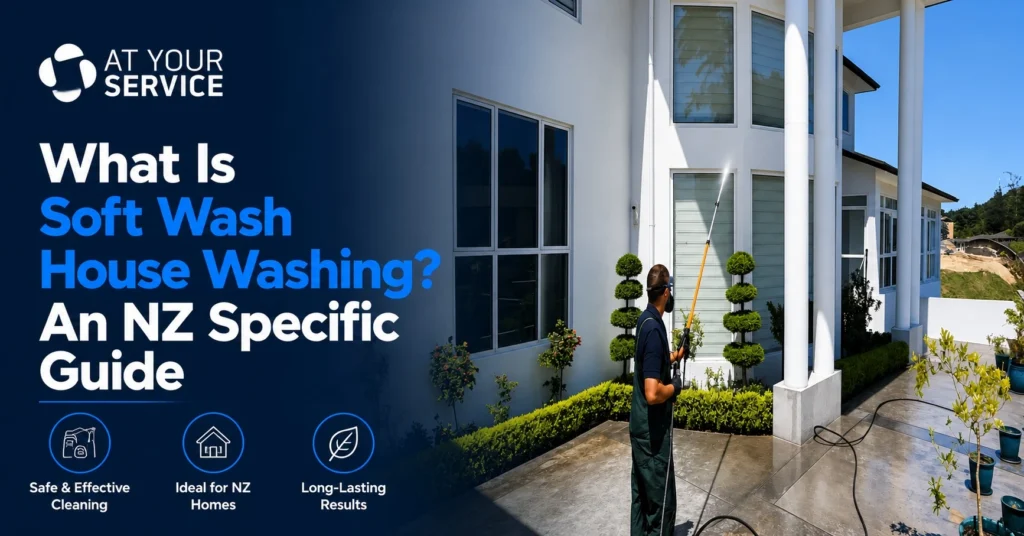
Soft wash house washing is a low-pressure exterior cleaning method that uses biodegradable chemical solutions to remove mould, algae, lichen, moss, and grime from a home’s exterior surfaces. Unlike water blasting, which relies on high-pressure force to shift dirt, soft washing lets the chemistry do the work. The result is a deeper, longer-lasting clean that is safe for painted surfaces, weatherboard, render, and roofing materials that would be damaged by high pressure.
In this guide, you’ll learn exactly what soft wash house washing is, how the process works, which chemicals are used, which surfaces it suits, how it compares to water blasting, how much it costs in NZ, and when to DIY versus hire a professional.
Quick Answer: Soft wash house washing applies a diluted cleaning solution of sodium hypochlorite and biodegradable surfactants to the exterior of a house at low pressure (under 500 PSI). The solution dwells for several minutes, penetrating mould and algae at the root. The surface is then rinsed gently with low-pressure water. Results typically last 2 to 3 years, compared to 6 to 12 months from water blasting.
Soft Wash vs Water Blasting
| Factor | Soft Wash House Washing | Water Blasting |
| Water pressure | Under 500 PSI | 1,500 to 4,000 PSI |
| Cleaning agent | Sodium hypochlorite plus surfactant | Water only or minimal chemical |
| How it cleans | Chemistry dissolves contaminants at the root | Pressure physically blasts dirt from surface |
| Safe for painted weatherboard | Yes | Risk of damage at high pressure |
| Safe for roofing materials | Yes | Risk of tile cracking or shingle lifting |
| Results duration | 2 to 3 years typically | 6 to 12 months typically |
| Risk of water ingress | Very low when applied correctly | Moderate to high if misused |
| Best suited for | House exteriors, roofs, fences, decks | Concrete driveways, paths, hard paving |
What Is Soft Washing? How It Works
Soft washing is a cleaning technique that uses low-pressure water combined with specialised solutions to safely remove dirt, mould, mildew, and algae from home exteriors. Unlike pressure washing, which can damage delicate surfaces, soft washing allows the chemical solution to do the heavy lifting.
Soft washing delivers a cleaning solution at garden-hose pressures, under 500 PSI, allowing the chemicals rather than force to do the work. The detergents are biodegradable and designed to break down mould, moss, and biofilm so they rinse away gently. Because the spray is soft, it is safe for painted weatherboards, cedar, stucco, Colorsteel roofing, and even double-glazed windows.
The core distinction from water blasting is this: soft washing kills biological growth at the root. A salt-based sodium cleaning product used at the correct strength removes stains and makes surfaces look clean without harsh pressure or excessive brushing. Because the biology is killed rather than just removed from the surface, results hold for significantly longer.
The cracks and pores of exterior surfaces absorb the cleaning solution, breaking down mildew, dirt, and mould from within. After the solution has dwelled, a low-pressure rinse removes the solution along with the lifted contamination.
What Chemicals Are Used in Soft Wash House Washing?
The cleaning solution for residential soft house washing typically includes sodium hypochlorite (bleach) and a foaming or surfactant agent. When used properly, bleach is very effective and safe. It is the same chemical used in the treatment and disinfection of drinking water and swimming pools.
Soft washing uses low-pressure water combined with biodegradable cleaning solutions such as sodium hypochlorite. This is ideal for cleaning weatherboards, removing mould, and preserving paint finish.
The typical NZ professional house wash solution consists of:
Sodium hypochlorite (NaOCl):
The active biocide that kills mould, algae, lichen, and moss at the root rather than just removing the visible growth.
Surfactant or detergent:
A biodegradable blend of surfactants and cleaning agents effective on mould, mildew, algae, grease, and grime, and safe on most exterior surfaces including weatherboard and render. The surfactant helps the solution cling to vertical surfaces for the required dwell time.
Water:
Used to dilute the solution to the appropriate concentration for the surface type. A dilution ratio of up to 1 to 40 parts of water is recommended, although a lower dilution ratio may be needed depending on the level of soiling.
Can You Make Your Own House Wash Mix?
Yes, a DIY house wash mix is achievable. A good rule of thumb when using bleach is to dilute it to 1% bleach in water. Follow the instructions on the bottle if using a store-bought cleaning agent.
However, getting the concentration right matters significantly. Too little solution and the biological growth is not killed at the root, meaning it returns faster. Too much and there is risk of plant damage or surface discolouration. Pre-mixed professional house wash concentrates from NZ suppliers like Chemmate are available in 5L, 20L, and 200L sizes and take the guesswork out of mixing ratios.
How to Soft Wash a House?
Step 1: Inspect the Exterior Surfaces
Before applying any solution, walk the entire property and identify surface types (weatherboard, render, brick, Colorsteel, timber), areas of heavy biological growth, any cracked or damaged cladding, and proximity of plants and garden beds to washing areas.
Cracked or damaged cladding needs flagging before any wash. Moisture behind weatherboards leads to rot, swelling, and structural issues. Homes with ageing paintwork or any minor cracking in the cladding face the highest risk if water is forced in during washing. This inspection step protects against making a pre-existing issue worse.
Step 2: Protect Plants, Windows, and Outdoor Areas
House wash solutions will not damage plants when used correctly, and biodegradable formulas are safe on lawns. That said, pre-rinsing garden beds near the house and covering sensitive plants before application is standard professional practice, particularly when working with higher-concentration solutions for heavy mould coverage.
Cover outdoor furniture, children’s toys, and any items that could hold chemical residue. Close all windows and doors, and inform neighbours if washing near a shared boundary. For guidance on protecting aluminium window frames during exterior washing, our article on how to clean aluminium window frames covers what to avoid and what products are safe near joinery.
Step 3: Apply the Soft Wash Solution
Premix the solution according to surface type. Apply it through the venturi system using the chemical nozzle. Start from the base of the house and work upwards toward the gutters to reduce streaking caused by runoff. Apply to manageable sections and allow sufficient dwell time without letting the mixture dry before rinsing.
Working in sections of 3 to 5 square metres at a time, coat each area of the wall with the cleaning mixture starting from the bottom and moving upwards. Avoid windows where possible.
Step 4: Allow the Solution to Work
This step is where soft washing differs most from water blasting in terms of results. The dwell time allows sodium hypochlorite to penetrate biological growth and kill it at the root, rather than simply lifting the surface growth.
Spray the entire house exterior from top to bottom, leave for 10 minutes, then pressure hose. Optimum cleaning is achieved by allowing this dwell time before rinsing.
Do not allow the solution to dry on the surface before rinsing. In hot or windy NZ weather, work in shaded sections and keep the solution slightly wet if needed. For particularly stubborn mould or lichen, a second application on the affected area produces better results than extending dwell time on a drying surface.
Step 5: Rinse Using Low Pressure
Attach the soft wash nozzle and rinse gently in the same order you applied the cleaning solution. Begin with gutters, soffits, cladding, and baseboards before finishing with window frames.
Rinse thoroughly. Any remaining surfactant left on the surface attracts dust and can create a film. Pay particular attention to window frames and sills, which can hold chemical residue in corners. Our guide on how to clean outside windows covers the post-wash window rinse process in more detail.
Dispose of the chemicals safely and wash your hands thoroughly afterward. Throw any clothes that may have been in contact with chemicals straight into the wash.
Which Surfaces Can Be Soft Washed?
Soft wash house washing is safe and effective across all common NZ exterior cladding types.
Soft washing is safe for painted weatherboards, cedar, stucco, Colorsteel roofing, and even double-glazed windows. Because the chemical solution works at the root level, biological growth is killed rather than just displaced.
Surfaces suited to soft washing:
- Painted weatherboard (the most common NZ residential cladding)
- Rough or smooth render and plaster
- Brick and block
- Fibre cement and James Hardie cladding
- Colorsteel and Zincalume roofing
- Timber decks and fences (with appropriate dilution)
- Concrete tile roofing
- Roof soffit and fascia boards
Surfaces requiring water blasting or a different approach:
Water blasting is better suited to hard, durable surfaces like concrete driveways, footpaths, and stone paths where heavy grime and debris need to be removed and high pressure carries no surface risk.
The typical NZ property benefits from a combination approach: soft washing for the house exterior, roof, and fence, water blasting for the driveway and concrete paths.
Why Soft Wash Matters for NZ Homes Specifically
New Zealand’s climate creates conditions that accelerate biological growth on exterior surfaces faster than most homeowners expect.
Salt air is relentless in coastal areas. Combined with months of high humidity and rain, these conditions actively encourage mould, algae, and lichen to colonise exterior cladding. Left unchecked, biological growth spreads fast and gets harder to shift.
In the damp Waikato and Central Plateau, where autumn rains, winter frosts and spring pollen all test a building’s exterior, combining the right method with biodegradable chemistry is critical for both curb appeal and long-term surface protection.
The impact on paint is particularly important. Regular house washing directly protects your paint system and extends its life. Airborne contaminants including salt deposits settle on paint film and can attack the surface, causing premature breakdown. Moss and lichen penetrate the surface of paint, damaging its integrity. Mould growth can destroy the chemical entity of the resin system that holds the paint together. The presence of moss, mould, and lichen also holds moisture on the surface longer, promoting further growth and increasing the risk of damage to the coating.
In our experience washing house exteriors across New Zealand, the properties that require repainting earliest are almost always those that haven’t been washed in 3 or more years. A regular soft wash costs a fraction of a repaint. It is preventative maintenance, not cosmetic work.
How Often Should You Soft Wash a House in NZ?
An annual soft house wash is generally recommended by most painters and is often a condition of the warranty provided by paint manufacturers. This recommendation aligns with Resene’s official maintenance guidance, which advises regular washing to preserve the integrity of their paint systems on NZ homes.
In practice, the right frequency for your home depends on location and exposure:
Coastal properties (within 5km of the coast):
Every 12 months. Salt air and humidity accelerate biological growth and paint degradation faster in these areas.
Urban and suburban NZ (inland):
Every 12 to 24 months. Properties with high shade, southern-facing walls, or mature tree coverage may need annual washing despite being inland.
Properties with significant tree overhang:
Every 12 months. Leaf tannins and debris create organic matter that accelerates mould and algae on the surfaces below.
Because soft-washed results treat biological growth at the root rather than just lifting surface growth, results typically hold for 2 to 3 years compared to 6 to 12 months from a water blast. This means fewer required cleans over the life of the property.
How Much Does Soft Wash House Washing Cost in NZ?
Soft wash house washing is priced based on property size, storey count, surface condition, and region.
Typical NZ pricing ranges:
- Small single-storey home (up to 100m² floor area): $200 to $350
- Medium single-storey home (100 to 180m² floor area): $300 to $500
- Large single-storey or two-storey home: $400 to $700
- Large two-storey with significant mould or lichen coverage: $600 to $1,000+
These are estimates based on current NZ market pricing. Actual quotes vary by company, region (Auckland and Wellington tend to sit at the higher end), and whether roof washing, driveway blasting, or window cleaning are bundled into the same visit.
Getting a combined house wash and roof clean in the same booking generally produces a meaningful cost saving compared to booking each service separately, since the mobilisation and setup cost is shared across both jobs.
Should You Soft Wash Your House Yourself or Hire a Professional?
DIY soft washing is achievable for single-storey homes in good condition. It requires the correct chemicals, a low-pressure application system, and careful dilution. Getting the concentration wrong or using high pressure to compensate for a weak solution are the two most common DIY mistakes, and both can cause surface damage or premature regrowth.
If you’re unsure, never guess. Using the wrong method can be costly. Exterior cleaning done correctly is preventative maintenance, not cosmetic work.
DIY is viable when:
- The property is single-storey with easy ground-level access
- Mould and algae are surface-level with no deep penetration
- You are comfortable handling sodium hypochlorite safely
- You can obtain and correctly dilute professional-grade house wash concentrate
Hire a professional when:
- The property is two-storey or has areas requiring height access
- There is heavy or long-standing biological growth
- Cladding is older, cracked, or painted with an older paint system
- You want results that carry a service guarantee
- You’re preparing the property for sale or an inspection
For most NZ homeowners, a professional house washing service delivers better results with less personal risk, particularly on two-storey properties and roofs where access and chemical concentration both matter significantly. For a no-obligation quote on soft wash house washing in your area, contact our team for a free assessment.
Common Soft Washing Mistakes to Avoid
Using too high a concentration.
Over-concentrated sodium hypochlorite can bleach timber staining and discolour some painted surfaces. Always follow the manufacturer’s dilution guide and start conservative.
Not allowing enough dwell time.
Rinsing before the solution has worked means surface contamination is removed but the root biology survives and regrows quickly.
Letting the solution dry on the surface.
Dried solution is harder to rinse and can leave residue marks, particularly on windows and darker painted surfaces.
Using the wrong pressure.
A common DIY error is turning up the water pressure when the solution doesn’t appear to be doing enough. More pressure on weatherboard, render, or roofing causes damage. If the solution isn’t working, the issue is concentration or dwell time, not pressure.
Not protecting plants.
Even biodegradable solutions at higher concentrations can affect sensitive plants. Pre-rinse garden beds and cover anything close to the wash area before applying the solution.
Frequently Asked Questions
What is the difference between soft washing and water blasting?
Water blasting uses high-pressure water to remove dirt and grime from surfaces, whereas soft washing uses a low-pressure technique and specialised cleaning solutions to gently remove contaminants. Soft washing is preferred for delicate surfaces or where high-pressure washing may cause damage. Water blasting is better suited for hard surfaces that require more aggressive cleaning.
What chemicals are used to soft wash a house?
The cleaning solution typically includes sodium hypochlorite (bleach) and a foaming or surfactant agent. When used properly, bleach is very effective and safe, as it is the same chemical used in the treatment and disinfection of drinking water and swimming pools. Professional house wash concentrates from NZ suppliers combine these in a pre-blended biodegradable formula.
How long should the soft wash solution remain on the house?
Spray the entire exterior, leave for 10 minutes, and then rinse. Optimum cleaning is achieved by allowing this dwell time before rinsing. Do not allow the solution to dry on the surface before rinsing.
Is soft washing safe for painted surfaces?
Yes. Soft washing is safe for painted weatherboards, cedar, stucco, and Colorsteel roofing. Because the solution is applied at low pressure, there is no risk of paint damage from water force. Correct dilution is important since overly concentrated bleach-based solution can affect some paint finishes.
Can soft washing damage plants or lawns?
Professional house wash solutions will not damage plants when used at the correct dilution. Pre-rinsing garden beds near the house before application and covering sensitive plants is standard professional practice as an additional precaution.
How long do soft washing results last?
Because soft washing treats biological growth at the root, results typically hold for 2 to 3 years compared to 6 to 12 months from water blasting. Coastal properties with high salt and humidity exposure may see shorter result durations and benefit from annual washing.
Can soft washing remove mould, moss, algae, and lichen?
Yes. This is what soft washing is specifically designed to do. The sodium cleaning product used at the correct strength removes stains and biological growth, making surfaces look clean without harsh pressure. Deep-set lichen, which has adhered over many years, may require a second application or a period of weeks for the dead growth to fully loosen and wash off naturally with rain.
Can you soft wash a house in the rain?
Light rain during or after a soft wash is generally fine and aids rinsing. Heavy rain immediately after application can dilute the solution before it has completed its dwell time, reducing effectiveness. Avoid applying solution in heavy rain or strong wind. Most NZ house washing professionals monitor weather forecasts and reschedule if significant rain is expected within an hour of application.
What chemicals are used to soft wash a house?
The cleaning solution typically includes sodium hypochlorite (bleach) and a foaming or surfactant agent. When used properly, bleach is very effective and safe, as it is the same chemical used in the treatment and disinfection of drinking water and swimming pools. Professional house wash concentrates from NZ suppliers combine these in a pre-blended biodegradable formula.
How long should the soft wash solution remain on the house?
Spray the entire exterior, leave for 10 minutes, and then rinse. Optimum cleaning is achieved by allowing this dwell time before rinsing. Do not allow the solution to dry on the surface before rinsing.
Is soft washing safe for painted surfaces?
Yes. Soft washing is safe for painted weatherboards, cedar, stucco, and Colorsteel roofing. Because the solution is applied at low pressure, there is no risk of paint damage from water force. Correct dilution is important since overly concentrated bleach-based solution can affect some paint finishes.
Can soft washing damage plants or lawns?
Professional house wash solutions will not damage plants when used at the correct dilution. Pre-rinsing garden beds near the house before application and covering sensitive plants is standard professional practice as an additional precaution.
How long do soft washing results last?
Because soft washing treats biological growth at the root, results typically hold for 2 to 3 years compared to 6 to 12 months from water blasting. Coastal properties with high salt and humidity exposure may see shorter result durations and benefit from annual washing.
Can soft washing remove mould, moss, algae, and lichen?
Yes. This is what soft washing is specifically designed to do. The sodium cleaning product used at the correct strength removes stains and biological growth, making surfaces look clean without harsh pressure. Deep-set lichen, which has adhered over many years, may require a second application or a period of weeks for the dead growth to fully loosen and wash off naturally with rain.
Can you soft wash a house in the rain?
Light rain during or after a soft wash is generally fine and aids rinsing. Heavy rain immediately after application can dilute the solution before it has completed its dwell time, reducing effectiveness. Avoid applying solution in heavy rain or strong wind. Most NZ house washing professionals monitor weather forecasts and reschedule if significant rain is expected within an hour of application.