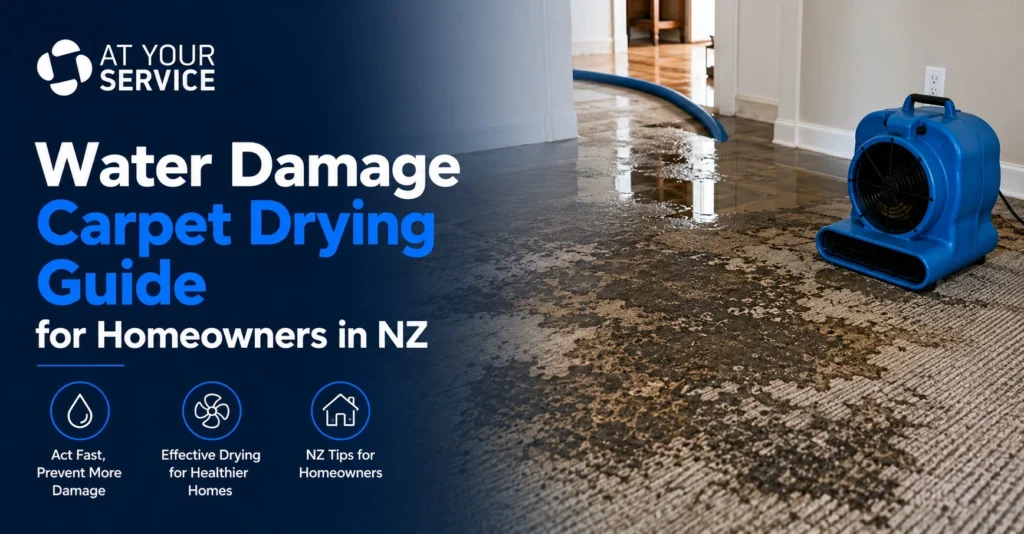
Water damage carpet drying is time-critical in a way that most other home cleaning problems are not. Mould can begin growing in wet carpet within 24 to 48 hours in New Zealand’s humid climate. Whether the damage came from a burst pipe, a roof leak, an overflowing appliance, or flooding, the decisions you make in the first few hours determine whether the carpet can be saved and how much the damage ultimately costs.
The right approach depends on how much water is involved, where it came from, and how long the carpet has been wet. In this guide, you’ll learn how to assess water damage immediately, what to do before professionals arrive, how professional carpet drying works, when carpet must be replaced rather than restored, and how NZ insurance covers water damage restoration.
Quick Answer: Stop the water source immediately. Remove furniture and extract visible water using towels or a wet-dry vacuum. Run fans and open windows. Lift a corner of the carpet to check the underlay. Call a professional water damage restoration service if the carpet has been wet for more than a few hours, if the water came from a contaminated source, or if the damage covers a large area. The 24-hour window is critical. Surface drying alone is not enough.
Water Damage Response Guide
| Situation | Urgency | DIY or Professional | Key Risk |
| Small clean water spill, caught within 1 hour | Moderate | DIY manageable | Underlay moisture if not fully extracted |
| Burst pipe, larger area, caught within 12 hours | High | Professional recommended | Subfloor moisture, rapid mould onset |
| Flooding from outside or stormwater | Very high | Professional required | Contaminated water, structural risk |
| Sewage or greywater overflow | Immediate | Professional only | Health hazard, Category 3 water |
| Carpet wet for more than 24 hours | Critical | Professional, possible replacement | Mould established, structural damage beginning |
| Carpet wet for more than 48 to 72 hours | Emergency | Professional assessment for replacement | Mould present, subfloor likely damaged |
| Water from roof leak, slow over weeks | Assessment needed | Professional assessment | Gradual damage, usually not insured |
Why Speed Determines Everything (The 24-Hour Rule)
This is not generic caution. It is the central fact around which every other decision in this guide is organised.
Mould can start growing within 24 to 48 hours after a flood. In Auckland’s humid climate, mould can start to grow in as little as 36 hours. Bacteria and mould can begin amplifying within 12 to 48 hours in warm, humid environments.
The damage timeline for untreated wet carpet in NZ conditions runs like this:
Within 24 hours: mould spores become active in wet carpet fibres. Within 48 hours: mould colonies establish and deodourisation becomes necessary. Within 72 hours: timber subfloor begins to swell and warp. After one week: structural damage to subfloor and framing may be irreversible.
The underlay is where this clock moves fastest. Your carpet underlay is made of porous foam that acts exactly like a giant sponge, trapping the majority of the water and holding it directly against your wood or concrete subfloor. Domestic dehumidifiers simply cannot extract this trapped moisture. Within 24 to 48 hours in Auckland’s humid climate, that dark, stagnant space becomes a breeding ground for mould and structural rot.
In our experience attending water damage callouts across New Zealand, the single most consistent finding is that homeowners who wait to see if the carpet dries on its own always face a more serious and more expensive outcome than those who act within the first few hours. The 24-hour window is not a guideline. It is a deadline.
The 3 Categories of Water Damage
The type of water determines the cleaning and health risk, and it directly affects whether carpet can be saved.
Category 1:
Clean water. Water from burst supply pipes, overflowing sinks, rainwater, and broken water heaters. Carries no significant health risk and carpet can almost always be saved if treated promptly.
Category 2:
Grey water. Water from washing machine discharge, dishwasher overflow, or water that has sat and begun to degrade. Contains some contaminants. Carpet can often be saved with appropriate antimicrobial treatment.
Category 3:
Black water. Sewage overflow, floodwater from rivers or stormwater, or any water that has contacted human waste. Contains significant biological hazards. Carpet and underlay from Category 3 events almost always requires replacement rather than restoration. It is only really dirty or brown water, such as flood mud, silt, or sewage, that can damage a carpet and underfelt sufficiently to necessitate full replacement.
If you are unsure of the water source, treat it as Category 2 minimum until confirmed otherwise.
What to Do Immediately Before the Professionals Arrive
These steps apply to Category 1 and Category 2 events where you are waiting for professional help or making an initial assessment.
Safety First
Turn off electricity to the affected area before entering if there is any possibility that water has reached power outlets, skirting board wiring, or underfloor wiring. Water and live electrical circuits are a fatal combination.
Stop the Source
No drying effort is meaningful while water continues entering the area. Find and stop the source completely before starting any extraction or drying.
Document Everything
Take photographs and video of all affected areas before removing anything. This documentation is critical for insurance claims. Note the date and time. Photograph the source of the water, the extent of wet carpet, any visible damage to walls, skirting boards, and furniture.
Remove Furniture
Move all furniture off wet carpet immediately. Place aluminium foil or plastic sheeting under furniture legs that cannot be moved, to prevent rust and dye transfer to wet carpet that can cause permanent staining.
Extract Standing Water
Use a wet-dry vacuum to remove as much standing water as possible. If you don’t have one, thick towels pressed firmly onto the carpet surface and wrung out repeatedly are the next best option. The more water removed at this stage, the slower the damage progresses while you wait for professional help.
Check the Underlay
Lift the carpet at the nearest edge or corner. Inspect the underlay. If it is wet, note the extent. This information is useful for professionals when they arrive. A soaked underlay that has been wet for more than 12 to 24 hours will almost certainly need replacement regardless of other factors.
Ventilate
Open all windows and doors in the affected room and adjacent spaces. Run fans if available. Good airflow slows mould onset while waiting for professional drying equipment.
For a detailed guide on DIY drying techniques and what tools work best in the first hours, our how to dry wet carpet guide covers every step in detail.
Why Surface Drying Doesn’t Work
This is the most important technical concept in this entire guide.
The biggest mistake Auckland homeowners make is trying to dry wet carpet from the top down. Throwing a heater in the room, pointing a domestic fan at the carpet surface, and waiting addresses exactly 10% of the problem.
The real danger is trapped moisture. The carpet underlay acts exactly like a giant sponge, trapping 90% of the water and holding it directly against the wood or concrete subfloor. Domestic dehumidifiers simply cannot extract this trapped moisture.
Wet carpets need to be lifted. The underlay needs to be removed and dried. Dehumidifiers don’t act quickly enough at surface level. They start at the surface but don’t tackle the water at deeper levels. Water soaks into the underlay and can start forming mould after 24 hours, before a dehumidifier can reach it.
This is why professional water damage restoration produces better outcomes than DIY surface drying even when the homeowner uses the correct tools. Professional equipment extracts from the full depth of the carpet system, not just the surface. Understanding this also explains why a carpet that appears dry on the surface can still develop musty odours and mould weeks after a water event.
How Professional Water Damage Carpet Drying Works
Professional flood restoration and carpet drying in NZ uses a scientific drying process built on IICRC (Institute of Inspection, Cleaning and Restoration Certification) standards.
Step 1: Moisture Mapping and Assessment
When a professional team arrives, the first step is a moisture assessment of the full property. This uses calibrated moisture meters and thermal imaging to map the exact boundary of water penetration, including areas not visible to the eye such as wall cavities, subfloor spaces, and under skirting boards.
Flood damage in NZ isn’t just about wet carpets. It is about moisture trapped in wall cavities, timber frames, and underlay. Without professional extraction and structural drying, secondary damage like toxic mould growth can begin in as little as 24 to 48 hours.
Step 2: Industrial Water Extraction
Industrial-grade extractors are significantly more powerful than consumer wet-dry vacuums. They extract water from the full depth of the carpet system including the underlay in a single pass, reducing the volume of moisture the drying equipment then needs to address.
Step 3: Carpet Lifting and Underlay Assessment
Professional teams lift the carpet from the edges and remove or treat the underlay directly. This step is essential and cannot be skipped. If underlay is soaked and has been wet for more than 12 to 24 hours, it is typically replaced rather than dried, since the cost of drying underlay to a safe standard often exceeds replacement cost.
Step 4: Industrial Air Movers and LGR Dehumidifiers
LGR (Low Grain Refrigerant) dehumidifiers are significantly more powerful than domestic units. They can process large volumes of moisture-laden air and reduce ambient humidity to the level required for effective drying. These are used in combination with high-velocity air movers positioned under lifted carpet and throughout the affected space.
Step 5: Anti-Microbial Treatment
Once extraction is complete, professional teams apply antimicrobial treatment to the carpet backing, subfloor, and any adjacent building materials to inhibit mould and bacteria growth during the drying period.
Step 6: Moisture Monitoring and Documentation
During the drying period, typically 2 to 5 days for standard events, professional teams return to monitor moisture readings daily. Documentation of these readings is essential for insurance claims. Technicians visit and inspect the water damage restoration site every 24 to 48 hours.
Step 7: Re-laying and Re-stretching
Once moisture readings confirm the carpet system has reached safe levels, the carpet is re-laid and re-stretched if required. If the carpet has shrunk, distorted, or the underlay was replaced, re-stretching by a professional ensures the carpet lies correctly without rippling or lifting at edges.
For water damage carpet drying and flood restoration services across New Zealand, professional teams can typically respond within hours of the initial call and begin extraction the same day.
Can Carpet Be Saved After Water Damage?
This is the most practical question after a water event and deserves a direct answer.
Carpets are generally salvageable every time if the water is not classed as contaminated. It is possible to save carpets through swift action to extract the water. Reputable carpet contractors will lift the fitted carpet to aid drying and do their best to save the underfelt.
If Category 1 clean water damage is treated professionally within 24 hours, the carpet can almost always be saved. The underlay may still need replacing, but this is significantly cheaper than full carpet replacement.
Replacement is likely necessary when:
- The water was Category 3 (sewage, heavily contaminated floodwater)
- The carpet has been wet for more than 48 to 72 hours without professional extraction
- Visible mould is present in the carpet backing or pile
- The carpet has physically shrunken, distorted, or the pile is matted beyond recovery
- The subfloor has been damaged to the point that re-laying is not viable
The insurance consideration:
Insurers are aware that clean water damage, such as burst water supply pipes and geyser events, can most often be cleaned. It is only really dirty or brown water that can damage a carpet and underfelt sufficiently to necessitate full replacement. Understanding this distinction helps you present your claim accurately.
For carpet that has developed mould after extended wet conditions, our guide on how to remove mould from carpet explains the severity and treatment options, but advanced mould in carpet backing typically means replacement is more cost-effective than restoration.
NZ Insurance Coverage for Water Damage Carpet Drying
This section addresses one of the most common questions after a water damage event, and it is not well-answered by most carpet drying guides in NZ.
What is Typically Covered
NZ house insurance generally covers sudden water and weather damage including storms, burst pipes, and flooding. Replacing damaged carpet or furniture (if you have contents insurance too) and specialist drying and cleaning services, like hiring a dehumidifier, are typically covered.
Homeowner’s insurance covers floods from bursting pipes, water heater leaks, and dishwasher and washing machine overflow, including overflowing sinks and bathtubs.
Water extraction, cleaning, and sanitising, as well as structural drying including professional dehumidification equipment and repair or replacement of damaged building materials (including flooring), are typically covered.
What Is Not Covered
Damage caused by slow leaks or any gradual process of water ingress giving rise to damp, rot, decay, moss, mildew, and so on is not covered by insurance policies. Examples include leaking or corroded pipes that have been dripping for months, failed waterproofing, and lack of ventilation.
Gradual damage is the most important exclusion to understand. If a pipe has been slowly leaking for weeks or months, resulting in carpet damage, this is generally excluded even if the damage is only discovered suddenly.
EQC and Natural Disaster Cover
EQC (now Toka Tu Ake) covers natural disaster flooding. EQC cover is automatically included when you hold a private home insurance policy. You do not need to purchase it separately. The current EQC cap is $300,000 plus GST for dwelling damage. Your private insurance company handles the claims process on behalf of EQC.
NZ house insurance generally covers sudden water and weather damage but excludes gradual damage, poor maintenance, and wear and tear.
Documentation for Claims
If you need to make a claim for water or flood damage, document everything. Take photos of the damage and keep records of any urgent repairs you have done.
Professional restoration companies provide the exact documentation your insurer needs: detailed moisture maps identifying the invisible boundary of water damage, daily moisture logs showing proof of drying progress, and comprehensive reports of work completed. This documentation significantly accelerates claims processing and reduces disputes with insurers.
Water Damage Carpet Drying Cost in NZ
Understanding what professional services cost helps you make an informed decision and confirms whether a professional callout is worth pursuing under insurance.
Water extraction, cleaning, and sanitising typically costs around $22 per square metre with a minimum charge of approximately $330 for a 15 square metre area.
Full flood restoration including industrial drying equipment, daily monitoring, antimicrobial treatment, and re-laying typically ranges from $800 to $3,000 or more depending on the area affected, number of days of professional drying required, and whether underlay replacement is needed.
This cost is almost always covered by home and contents insurance for sudden and accidental water damage events. Getting professional help promptly, with full documentation, is therefore almost always the financially correct decision for significant water events, since professional restoration costs less than uninsured carpet replacement and prevents the structural damage costs that follow if moisture is left untreated.
Frequently Asked Questions
Can carpet be saved after water damage?
Carpets are generally salvageable if the water was clean or lightly contaminated and professional extraction begins within 24 hours. Category 3 contaminated water or carpet wet for more than 48 to 72 hours significantly reduces the chances of full recovery. Underlay often needs replacing even when the carpet itself can be saved.
How long does it take for carpet to dry after water damage?
With professional industrial drying equipment, most carpet systems reach acceptable moisture levels within 2 to 5 days. The subfloor and wall cavities may take longer depending on construction type and the extent of penetration.
Will carpet dry out after a water leak on its own?
Not effectively. Surface drying addresses only the top 10% of the moisture problem. The underlay and subfloor hold the majority of the water and cannot be adequately dried by surface methods. Professional extraction and industrial drying equipment are required for complete drying within the safe mould-onset window.
How do you tell if water is underneath carpet?
Lift a corner of the carpet and inspect the underlay. Press your hand firmly onto the underlay surface. If it feels damp, cold, or soft rather than resilient, moisture is present beneath the surface. A musty smell from the floor is also a reliable indicator of moisture in the underlay or subfloor.
Can I use a regular vacuum on wet carpet?
Never use a standard dry vacuum on wet carpet. It will be damaged by the moisture and creates an electrocution risk. Use only a wet-dry vacuum specifically rated for liquid extraction.
How long will it be before wet carpet smells?
In warm, humid NZ conditions, wet carpet underlay can begin producing odour within 24 to 36 hours. By 48 hours, musty smell is almost always present if the underlay remains wet. Surface odour that has developed indicates mould onset has likely already begun.
What should I do after finding a water leak?
Stop the source immediately. Turn off the water mains if it is a plumbing leak. Document everything with photos and video. Extract surface water with a wet-dry vacuum or towels. Call your insurer and a professional water damage restoration service. Do not wait to see if the carpet dries on its own.
Is dehumidification necessary for water-damaged carpet?
Yes, but domestic dehumidifiers are insufficient on their own for significant water damage. They address surface-level atmospheric moisture but cannot extract water trapped in underlay and subfloor at the rate required to stay within the mould-onset window. Professional LGR dehumidifiers combined with industrial air movers are the minimum equipment level for effective structural drying.
Does water damage carpet permanently?
Not always. Clean water damage treated promptly can be fully reversed with professional drying. Permanent damage occurs when carpet has been wet beyond the mould-onset window, when contaminated water has saturated the system, or when the subfloor has swollen or warped.
Will my insurance cover water damage carpet drying in NZ?
Home and contents insurance typically covers sudden and accidental water damage including burst pipes, appliance overflow, and flooding. Specialist drying and cleaning services are generally included in this cover. Gradual damage from slow leaks is usually excluded. Document the damage thoroughly and contact your insurer as soon as possible after a water event.
Can carpet be saved after water damage?
Carpets are generally salvageable if the water was clean or lightly contaminated and professional extraction begins within 24 hours. Category 3 contaminated water or carpet wet for more than 48 to 72 hours significantly reduces the chances of full recovery. Underlay often needs replacing even when the carpet itself can be saved.
How long does it take for carpet to dry after water damage?
With professional industrial drying equipment, most carpet systems reach acceptable moisture levels within 2 to 5 days. The subfloor and wall cavities may take longer depending on construction type and the extent of penetration.
Can I use a regular vacuum on wet carpet?
Never use a standard dry vacuum on wet carpet. It will be damaged by the moisture and creates an electrocution risk. Use only a wet-dry vacuum specifically rated for liquid extraction.
How long will it be before wet carpet smells?
In warm, humid NZ conditions, wet carpet underlay can begin producing odour within 24 to 36 hours. By 48 hours, musty smell is almost always present if the underlay remains wet. Surface odour that has developed indicates mould onset has likely already begun.
What should I do after finding a water leak?
Stop the source immediately. Turn off the water mains if it is a plumbing leak. Document everything with photos and video. Extract surface water with a wet-dry vacuum or towels. Call your insurer and a professional water damage restoration service. Do not wait to see if the carpet dries on its own.
Is dehumidification necessary for water-damaged carpet?
Yes, but domestic dehumidifiers are insufficient on their own for significant water damage. They address surface-level atmospheric moisture but cannot extract water trapped in underlay and subfloor at the rate required to stay within the mould-onset window. Professional LGR dehumidifiers combined with industrial air movers are the minimum equipment level for effective structural drying.
Does water damage carpet permanently?
Not always. Clean water damage treated promptly can be fully reversed with professional drying. Permanent damage occurs when carpet has been wet beyond the mould-onset window, when contaminated water has saturated the system, or when the subfloor has swollen or warped.
Will my insurance cover water damage carpet drying in NZ?
Home and contents insurance typically covers sudden and accidental water damage including burst pipes, appliance overflow, and flooding. Specialist drying and cleaning services are generally included in this cover. Gradual damage from slow leaks is usually excluded. Document the damage thoroughly and contact your insurer as soon as possible after a water event.